
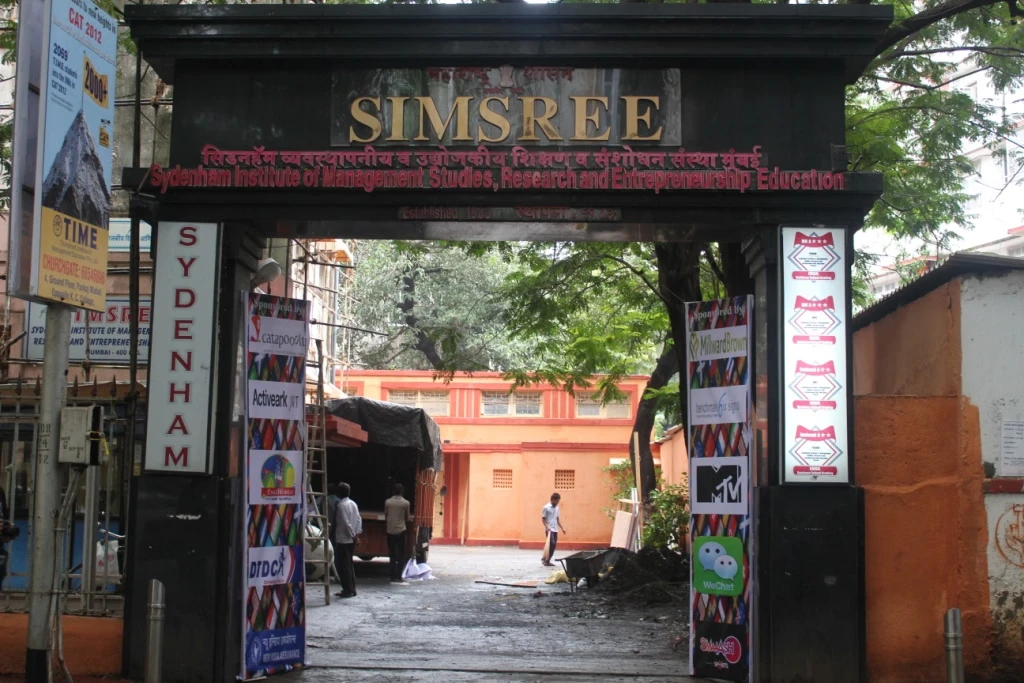

SIMSREE scholarships: what applicants can verify
SIMSREE’s public information confirms a scholarship-related channel through its alumni association, SIMAA. The association lists assistance to students through scholarships and prizes among its missions, but the page does not publish a current award catalogue, eligibility rules, amounts, application dates or recipient counts. Applicants should therefore treat this as evidence that alumni-supported assistance exists as a stated mission, not as a guaranteed award or a quantified reduction in course costs.
The institute’s NIRF 2025 submitted data reports zero students receiving full tuition-fee reimbursement from government, institute funds or private bodies in its table for the PG two-year programme. This is a specific full-reimbursement field in a submitted dataset; it does not show whether partial scholarships, prizes, loans, or aid in another academic year were available. The two sources answer different questions and should not be collapsed into a claim that SIMSREE offers no financial support.
Alumni assistance and prizes
SIMAA describes itself as an alumni association and lists rendering assistance to students through scholarships and prizes as part of its mission. That is the strongest current institute-linked public statement located for student awards. The page does not identify a named scholarship, annual budget, eligible programme or category, selection basis, amount, renewal condition or recent award cycle. It also does not say that every student can apply.
For a prospective MMS, M.Sc. Finance, MFM or MMM student, this means the association is a sensible contact for questions but not a source for budgeting a certain award into the cost of attendance. Ask whether aid is open for the intended course and intake, whether it is need- or merit-based, what documents are required and whether the benefit is a one-time prize or recurring tuition support. Confirm the application route and deadline in writing before relying on any verbal estimate.
What the NIRF reimbursement row does and does not say
In SIMSREE’s NIRF 2025 management submission, the full-tuition reimbursement table for PG two-year programmes lists 0 students receiving full reimbursement from State and Central Government, 0 from institution funds, and 0 from private bodies. The same table lists 156 students who are not receiving full tuition reimbursement; its total actual student strength entry is 372 across all programme years. These figures are for the reporting table in the submitted NIRF dataset, not a list of scholarship recipients or an award policy.
The phrase “full tuition fee reimbursement” is narrower than financial aid in general. It does not establish whether students received partial reimbursement, an alumni prize, a fee concession outside those categories, a bank loan, or support in another year. Nor should the table’s 372 all-years student strength be used as the denominator for a specific award. The responsible reading is limited: the submitted 2025 dataset reports no full tuition reimbursement in the three listed source categories for the reported programme population.
Plan costs without assuming an award
Build a first-pass budget from the current official fee notice for the exact programme and intake, then add travel or accommodation, food, books, deposits and other stated charges. SIMSREE programme pages and notices should be checked separately because full-time and part-time courses may have different fee structures. Do not subtract an unconfirmed scholarship from the amount due. The fee pages do not themselves prove that a student qualifies for a scholarship or that an award will arrive before fee payment.
If you need financial support, ask the institute and SIMAA early whether an application is open, the award’s selection basis and amount, when decisions are announced, how payment is made, and whether the award can be combined with other aid. Ask what happens if a student’s circumstances change or if an award is renewed annually. For external government schemes, confirm eligibility and deadlines with the scheme owner and the relevant Maharashtra or central portal; a general scheme page cannot substitute for programme, domicile, income or category-specific rules.
Also separate an award from a fee waiver. An award paid to a student after enrollment may help with expenses without changing the amount the institute requires by a particular due date. Ask for the payment schedule and invoice treatment, and keep enough liquidity for the initial fee instalment unless the official notice explicitly confirms a different arrangement. A loan is repayable finance, not a scholarship; compare interest, repayment start and guarantor terms separately if considering one.
Questions to ask before applying
Contact SIMSREE or SIMAA and request the current year’s written scholarship or prize notice. Confirm the course and intake covered, eligibility, selection criteria, number of awards, amount, application form, documents, deadline, renewal terms and payment timing. Ask whether the award reduces the institute invoice or is paid separately after selection. If the answer is that no current notice is available, budget using confirmed fees and treat support as uncertain.
As of 9 November 2026, SIMAA publicly states a scholarship-and-prize assistance mission, but detailed current award terms were not available on that page. The NIRF 2025 submission reports zero full tuition reimbursements in the three specified funding categories; it does not rule out partial or differently classified support. These limits are important for planning: applicants can investigate alumni assistance, but should not assume an award amount, eligibility or deadline until a current responsible notice confirms it.