Loading Admission Guardian content
Loading Admission Guardian content

Selected ranking categories, with the recorded year beside each result. Open all records for the complete history.
14 published records · Lower numeric ranks are stronger
NIRF
B.Tech
#902019
IIRF
Engineering · public
#762024
IIRF
B.Tech · public
#812022
Find a program, read its fee details and explore the admission requirements.
Summary of the programs shown below. Fee periods can differ by program. Check the note beside each amount before comparing costs.
| Course | Stream | Fees |
|---|---|---|
| Master of Computer Applications [M.C.A] | Computer Applications | 41000 |
| Master of Business Administration [MBA] | Management | 41000 |
| Master of Engineering [ME] | Engineering | 60000 |
| Bachelor of Engineering [BE] | Engineering | 220000 |
| Bachelor of Technology [B.Tech] (Industrial Biotechnology) | Engineering | 220000 |
Eligibility: Graduation
Specializations
Eligibility: Graduation
Specializations
Eligibility: Graduation with 50% + TANCET
Specializations
All accepted exams
Eligibility: 10+2 with 50% + TNEA
Specializations
All accepted exams
Eligibility: 10+2 with 50% + TNEA
1 exam with cutoff data available - showing recent entries
 Accenture
 Amazon
 Capgemini
 Cognizant
 Credit Suisse Business Analytics
 Exterro (I) Pvt. Ltd.
 HCL Technologies
 IBM
IBM Infosys
 Kale Consultants (Accelya Kale)
 Larsen & Toubro Ltd.
 Microsoft
 Murugappa Group
 Oracle
 Ramco Systems
 Robert Bosch Engineering & Business Solutions Ltd
 Symphony
 Tata Consultancy Services
 TELCO
TELCO Wipro
Wipro Zoho
ZohoIf you're looking for a government engineering college where the brand name still carries serious weight and the total four-year cost might be less than a single semester at a private competitor, Government College of Technology (GCT) Coimbatore demands your attention. Established in 1945 and affiliated with Anna University, this autonomous institution has built a reputation on pure, unvarnished value. It's a place where you trade gleaming glass facades for immense academic freedom and a near-zero debt graduation, a trade-off that thousands of students make every year. The campus, spread over 111 acres of prime Coimbatore land, feels like a world apart—lush, quiet, and steeped in a legacy that includes ISRO scientists and industry leaders. But make no mistake, this is a no-frills operation. The experience is defined by self-motivation, basic infrastructure, and a return-on-investment calculation that's hard to beat in Indian engineering education.
GCT operates as an autonomous college under Anna University, which means it sets its own curriculum and follows a relative grading system. That autonomy is a double-edged sword. It allows for academic flexibility, but it also means the onus is squarely on the student. The faculty, a mix of around 129 permanent professors and guest lecturers, is a strong point. A significant majority hold PhDs from institutes like IITs and Anna University itself. They're knowledgeable, but the teaching style here isn't about hand-holding. The consensus from student reviews is clear: you'll need to be self-driven.
The undergraduate intake is substantial, around 1,300+ students across all years. The B.E. and B.Tech programs are the main draw, with Civil and Mechanical Engineering having the highest intake (120 each), followed by streams like CSE, IT, ECE, and EEE (60 each). The college has benefited from World Bank funding under the TEQIP program and has established Centers of Excellence in Environmental Studies and Alternate Energy Research. There are also MoUs with companies like Siemens, though the depth of these industry connections for the average undergraduate is sometimes debated by students online. For postgraduates, GCT offers a range of M.E. specializations and Ph.D. programs across departments.
This is where the GCT proposition gets interesting. The placement data requires a careful read, not just a glance at the highest number shouted in a brochure.
The median package, as reported in the official NIRF 2025 data, is ₹4.60 LPA for both UG and PG. That's a solid, realistic baseline for a government college. The average package tends to hover between ₹4.60 LPA to ₹6.0 LPA. Now, the high numbers: you'll see reports of a ₹14.15 LPA high, and even department-specific claims like ₹32 LPA for EIE. A ₹54 LPA figure floats around on some portals, but that's widely considered an outlier or unverified. Treat it with skepticism.
The placement percentage tells a more nuanced story. The official overall figure fluctuates, with 2024 seeing a dip to around 54% according to some trackers. But it's departmental. CSE, IT, and ECE often see placement rates of 85-90%. Core branches like Civil and Mechanical, however, typically range between 40-60%. This gap is crucial for prospective students to understand.
The recruiter list is impressive and a testament to the college's brand. IT giants like Amazon, Microsoft, Zoho, TCS, Infosys, and Wipro are regulars. On the core side, you have L&T, Bosch, Hyundai, Ashok Leyland, and Titan. A significant portion of placements (around 40%) are in IT services, with core engineering making up about 30%. The active alumni network (GCT Alma Connect) plays a huge role in bringing these companies to campus. The value for recruiters is obvious: they get access to capable students at a very low recruitment cost.
GCT's affordability is its superpower. The annual tuition fee for general category students is famously low, around ₹10,000 to ₹15,000. For First Graduate or SC/ST students, there are significant concessions, often reducing the tuition to between ₹4,000–₹7,000, or even waiving it entirely.
Hostel and mess fees add to the cost but keep it minimal. Hostel establishment charges are about ₹7,000 – ₹12,000 per year. The mess operates on a dividing system, costing roughly ₹2,300 – ₹2,800 per month for vegetarian food. Put it all together, and the total estimated cost for a four-year B.E. degree, including hostel and mess, falls between ₹80,000 to ₹1,50,000. That's less than a single year's fee at many mid-tier private colleges.
Financial aid is available through Tamil Nadu government community scholarships (BC/MBC/SC/ST) and the Pragati Scholarship for girls. Notably, the strong alumni network runs its own scholarship program to support students in need.
Admission to GCT's undergraduate programs is straightforward and transparent, with zero room for management quotas. It's 100% based on the TNEA (Tamil Nadu Engineering Admissions) counseling process, which uses your Class 12 marks (or equivalent) to generate a merit rank. There's no separate entrance exam for UG admissions.
The cutoffs are competitive, especially for the coveted branches. For the 2024 counseling round under the General Category:
These ranks give you a clear idea of the score you'd need in your board exams. For postgraduate (M.E./M.Tech) programs, admission is through GATE or the CEETA-PG (formerly TANCET) exam score.
Expect a mixed bag. The campus itself is a major plus—sprawling, green, and peaceful. The library is excellent, with over a lakh books and a digital section. Sports facilities include large grounds, an indoor stadium, a gym, and a swimming pool (though its operational status can vary).
The hostels, however, are where most student complaints converge. They're basic, dated, and student reviews consistently rate them around 2.5/5. The rooms are functional but lack modern amenities. The biggest ongoing issue is food. The vegetarian mess has been a point of distress, with reports as recent as late 2025 citing hygiene problems. Many students eventually opt for eateries in the nearby Saibaba Colony area.
A significant point of contention, frequently highlighted on forums like Reddit, is the disparity in hostel rules. While boys enjoy considerable freedom, girls face strict curfews (as early as 6:30 PM) and more restrictive access to facilities. It's a stark contrast to the otherwise liberal campus atmosphere, where there's no enforced dress code—a notable freedom compared to many private Tamil Nadu colleges.
Wi-Fi is available in academic departments but is notoriously weak or non-existent in hostels. The administrative processes can be slow, embodying typical government red tape for things like scholarship disbursals or certificate collection.
Synthesizing sentiment from education portals, Reddit, and Quora reveals a clear, consistent profile.
The positives are powerful and repeated: ROI and Freedom. The phrase "zero debt degree" is a mantra. Coupled with the freedom to manage your own time and the absence of a rigid dress code, it creates a collegiate experience that feels mature and self-directed. The alumni network is universally praised as being incredibly active and supportive. The green, serene campus is also a big favorite.
The negatives are equally consistent. Infrastructure decay tops the list—old buildings, poorly maintained washrooms (especially in the Science block), and a general lack of investment in modern facilities. The hostel food and hygiene issue is a constant headache. The self-learning culture means you must be proactive; faculty won't chase you. And the administrative speed (or lack thereof) tries the patience of many.
The verbatim consensus from students sums it up: "If you want a high-paying job with zero fees and don't mind living in a 1950s-style hostel, GCT is heaven." Another common take: *"The infrastructure is crumbling in some blocks, but the brand name still carries weight in the industry."
GCT Coimbatore is an institution for pragmatists. It's an excellent choice for a student who is self-motivated, cost-conscious, and primarily driven by securing a strong engineering foundation and a good job with minimal financial burden. If your family budget is tight, or you simply refuse to take on lakhs in education loans, GCT presents an unparalleled value proposition. The brand recognition, especially in South India and among core engineering and IT sectors, is genuine and will open doors.
However, if you prioritize a comfortable, modern campus life with premium hostel amenities, reliable Wi-Fi, and a more structured, spoon-fed academic environment, you will likely be frustrated here. The infrastructure challenges and hostel conditions are real. It's also less ideal for those who need constant external motivation to study.
In the perennial Tamil Nadu college comparisons, GCT isn't trying to beat PSG Tech in gloss or infrastructure. It's offering something different: a legitimate, respected degree at a price that feels almost from another era. For the right student, that's a deal worth making.
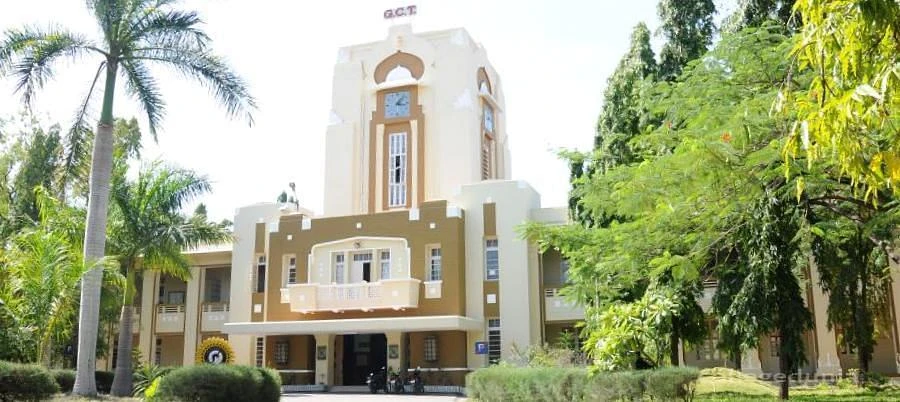
In this preview: 4 photos · 0 videos
PSG Tech is superior in infrastructure and industry exposure but is much more expensive. CIT is comparable, but GCT is often preferred for its significantly lower fees and government status.
For the General category, you typically need a TNEA rank within the top 2,000, which corresponds to a cutoff score of approximately 197 or higher.
Generally, no. Unlike many private colleges in Tamil Nadu, GCT is known for its liberal atmosphere regarding student attire.
The hostel food is basic and vegetarian. Recent reports have highlighted hygiene concerns, leading many students to opt for outside eateries in the nearby Saibaba Colony area.
No. As a 100% government-funded institution, all seats are filled exclusively through the TNEA/TANCA counseling process. There is no management or NRI quota available.
Share what future students should know about GCT.
Student voices are not rewritten by colleges. We remove spam and abuse.
Wider admission question? Community PulseWhat should future students know?
Tell us which course you're considering. We'll help you work out the next step.
Get instant Partner access after mobile verification. Your public edits are reviewed before they go live.
Claim this college
 Auditorium
 Cafeteria
 Computer Labs
 Gym
Gym Hostel
 Medical
 Science Labs
 Sports Complex
 Study Library