
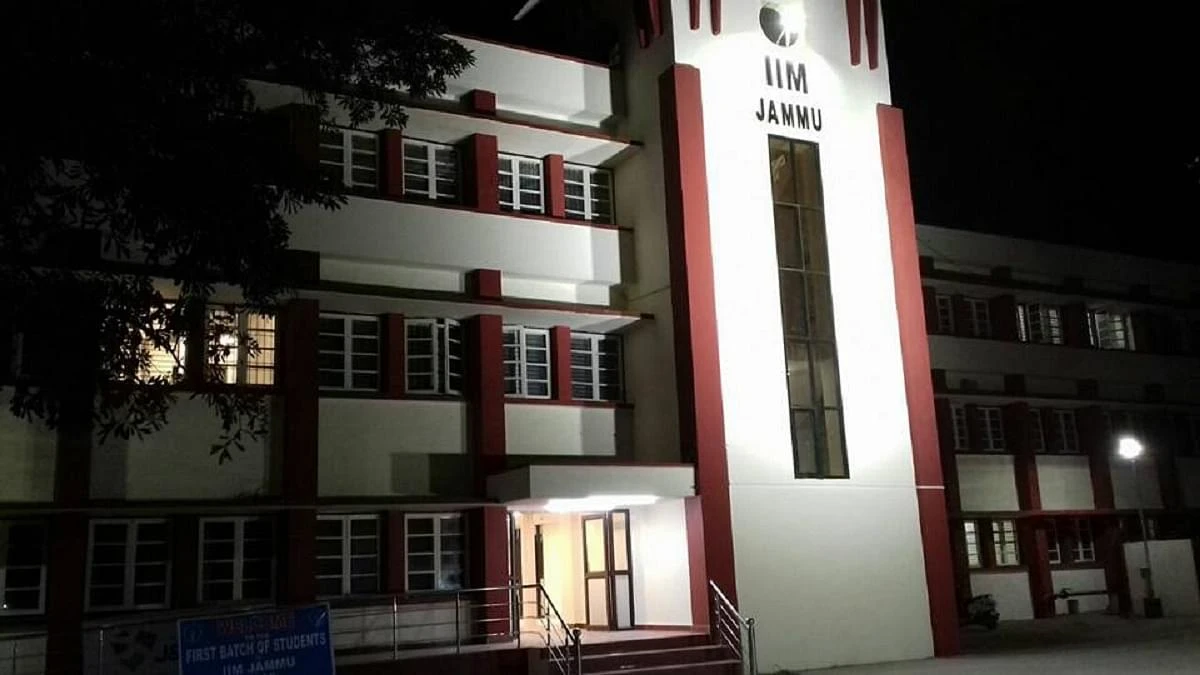

IIM Jammu admission: what the 2026-28 MBA policy shows
IIM Jammu has several entry routes, and the flagship MBA policy does not describe how to apply to every programme. The institute lists MBA, MBA in Hospital Administration and Health Care Management, MBA in AI and Business Analytics, the B.Tech-MBA dual degree with IIT Jammu, the five-year Integrated Programme in Management, Executive MBA, eBBA, BBA (Hons.) and doctoral study. Each has its own admission page and cycle. (IIM Jammu programme directory; About IIM Jammu)
The latest complete MBA policy captured for this page is for the 2026-28 batch. It specifies CAT 2025, a Personal Interview (PI), and a final merit score combining CAT, interview and profile marks. Its cutoffs, dates and payment rules are historical batch terms; they do not establish the process for a 2027-29 intake. Applicants should use the new policy when IIM Jammu publishes it. (MBA admission policy, batch 2026-28)
How the flagship MBA selection worked for 2026-28
The policy describes three stages: CAT 2025, shortlisting for PI, and the PI followed by a merit list. Clearing a published percentile threshold made an applicant eligible for consideration at the shortlisting stage; it did not guarantee a PI call or admission. IIM Jammu reserved the right to adjust section and overall thresholds after CAT results and says the Admission Committee could change them to reach its required number of interview candidates. That makes the table a record of the 2026-28 policy, not a stable score promise.
The table below shows the policy's minimum sectional and overall percentiles for PI shortlisting. The columns are VARC, DILR, Quantitative Ability and overall percentile. Gender rows are kept separate because the policy listed different thresholds for some categories.
These are minimum criteria printed for the 2026-28 PI shortlist. The policy says cutoffs may be raised or lowered after CAT results, and the committee decides how many candidates to call category by category. They are not the final admission cutoff, a CAT qualifying score set by IIM Jammu for every year, or a prediction of the 2027-29 threshold. The official policy also directs applicants to the CAT website for the examination itself. (MBA admission policy, batch 2026-28)
How the 2026-28 final merit score was built
For the 2026-28 policy, the final score was out of 100: CAT contributed up to 42 marks, PI up to 30, and the profile component up to 28. The profile component was divided into academic record (10), work experience (10) and gender diversity (8). An applicant’s CAT percentile alone therefore did not determine the final list.
The academic component used school and undergraduate marks. Class 10 contributed up to two marks, Class 12 up to three, and graduation up to five. The official table used percentage bands. For Class 10, the listed score rose from zero at 60% or below, to 0.5 for 60.01-70, 1 for 70.01-80, 1.5 for 80.01-90, and two marks above 90. For Class 12, the corresponding scores were zero, 1, 1.5, 2, 2.5 and 3 across the policy’s bands, with the top band beginning above 95%. Graduation carried zero up to 60%, then one mark for 60.01-70, 1.5 for 70.01-80, two for 80.01-85, three for 85.01-90, four for 90.01-95, and five above 95%.
The work-experience table rewarded completed months of full-time, remunerated work after graduation. It assigned zero marks through 12 months, four for 12.01-18 months, seven for 18.01-24, ten for 24.01-36, seven for 36.01-48, four for 48.01-60, and zero above 60 months. The policy excludes internships, part-time or project work, training, apprenticeship, articleship and pre-graduation experience. It also describes documentary proof for current and former employment, including employer letters; applicants should follow the checklist in the policy rather than assume a CV entry is enough.
The policy assigned eight diversity marks to female and transgender candidates and none to male candidates. It separately stated Government of India reservation percentages of 15% for Scheduled Caste, 7.5% for Scheduled Tribe, 27% for NC-OBC, 10% for EWS and 5% for PwD. Applicants should check the current policy for definitions, certificates, category treatment and any updates; the 2026-28 document is not proof that these selection weights or thresholds remain unchanged in a later batch. (MBA admission policy, batch 2026-28)
Offer acceptance and withdrawal: batch-specific dates matter
For the 2026-28 MBA cycle, the policy says an offer-acceptance payment of ₹50,000 was adjusted against the first-term fee. A candidate withdrawing by the listed 21 June 2026 deadline could receive a refund after a ₹1,000 processing charge; the policy gives different treatment after the deadline and after registration. It also describes a tentative refund window. Those dates have passed. Do not use them to decide whether a current offer can be accepted or withdrawn; read the exact offer letter and the current cycle’s policy before paying.
The official 2026-28 handbook adds an important cost distinction for applicants comparing offers: its first-term fee schedule and refundable caution deposit are separate lines, and mess charges are billed at actuals. A deposit or offer-acceptance adjustment should not be counted twice as a recurring tuition amount. For the complete MBA fee breakdown, consult the official current handbook and fee notice, then confirm which charges recur by term and which are refundable or billed at actuals. (MBA Handbook, batch 2026-28; MBA admission policy, batch 2026-28)
Do not transfer the flagship MBA rules to another programme
IIM Jammu’s programme directory links separate admissions for MBA (HA & HM), IPM, BBA (Hons.), eBBA, Executive MBA and PhD. The institute also lists partner-linked MBA formats, including healthcare with AIIMS Jammu and IIT Jammu, AI and Business Analytics with AIT Thailand, and a B.Tech-MBA dual degree with IIT Jammu. Those names do not establish their eligibility, test, interview, seat allocation or fee terms. Use the linked programme-specific policy and handbook, and check that the award, partner responsibilities and campus in the notice match the application you intend to submit. (IIM Jammu programme directory; About IIM Jammu)
The institute’s About page says it was established by the Government of India in 2016 and that it inaugurated an off-campus in Srinagar in January 2020. These institutional facts do not tell an applicant where a particular programme’s classes will be held. Confirm teaching location, reporting dates and any partner-campus schedule with the current programme notice before arranging housing or travel. (About IIM Jammu)
A practical application checklist
Before starting a new application, confirm the programme name and batch on the institute’s own page, identify the accepted test and test year, and read both eligibility and selection sections. For the flagship MBA, prepare the academic records used in profile scoring and the full-time post-graduation work certificates requested by the policy. Check category and disability documents against the latest notice. After a PI call, distinguish the shortlist threshold from the final merit formula. When an offer arrives, verify the acceptance amount, adjustment, refund deadline and withdrawal consequences in writing.
For the next MBA intake, the 2026-28 document is useful for understanding how IIM Jammu structured one recent selection cycle, but it is not the next-cycle rulebook. The captured sources do not establish the 2027-29 CAT year, cutoff table, weightings, dates or fees. Follow the current official MBA admission policy when issued; if the programme-specific policy has not yet appeared, treat the missing terms as unannounced rather than carrying forward last year’s values.