Loading Admission Guardian content
Loading Admission Guardian content

Explore the available options or ask for admission guidance.
Explore the available options or ask for admission guidance.
IIM Sirmaur has several routes for different stages of study: a two-year general MBA, tourism-focused MBA programmes, a four-year Bachelor of Management Studies (BMS), and doctoral study. The practical questions are which degree fits your stage, which campus and admission route apply, and what the published batch-specific costs and outcomes actually cover.
This guide is assigned to the 2027-28 publication edition. As of 5 November 2026, the official material reviewed for MBA admissions and fees is for the 2026-28 batch; BMS admission and fee pages cover 2026-30. Those figures are useful reference points, not confirmed 2027-intake rules or prices. The institute’s admission portal is the place to check when the next policy is released.
The two-year, full-time residential MBA is the institute’s general-management route after an undergraduate degree. IIM Sirmaur describes a six-term structure: three terms of mandatory first-year core courses, followed by an eight-to-ten-week summer internship, then three terms of electives. Its published elective areas include marketing, finance, economics, strategy, decision sciences, analytics, information technology, organisational behaviour, human resources, and operations and supply chain. This structure lets students build a broad base before choosing a concentration, but the institute’s current timetable and elective availability should be checked against the entering cohort’s course catalogue. The MBA programme page describes the programme design.
For applicants focused on tourism and related sectors, the official 2026-28 admission policy names both MBA (Tourism Management) and MBA (Tourism, Travel and Hospitality Management). The institute’s programme page describes MBA Tourism Management as a two-year, full-time residential degree with three trimesters each academic year, a six-to-eight-week summer internship, and second-year sector-specific core and elective courses. The separate TTHM route is also listed in the policy, so do not assume that the two titles mean identical curriculum, campus arrangements or fees. Compare their current programme briefs and admission notices before applying. The MBA TM page discusses tourism operations, destination planning, hospitality, airlines, policy and travel business; these are programme themes, not a promise of a specific job after graduation.
BMS is a four-year undergraduate programme. The 2026-30 brief describes interdisciplinary courses, practical industry exposure, research, internships, an international-exchange component, capstone projects and multiple exit options under the programme’s stated framework. Its 2026 admission policy uses the IPMAT aptitude-test score for the interview shortlist and final composite score. A separate PhD programme is listed on the institute site for research applicants. Because programme names, mode and intake can change, use the institute’s programme pages and admission portal to confirm the option currently open to your applicant group.
A useful first split is therefore academic stage, not ranking: the MBA and tourism MBAs are postgraduate choices; BMS is an undergraduate route; doctoral study has its own research criteria. Candidates comparing the tourism degrees should read the curriculum and mobility terms carefully, while BMS applicants should confirm whether the current cohort’s delivery mode and campus match their expectations. The broad campus page still describes a Paonta Sahib location for BMS, but that page predates the latest 2026 intake pages; get the location for the exact cohort in writing before making travel or housing plans.
The latest general MBA policy reviewed is for AY 2026-28. It uses CAT 2025 and the Common Admission Process (CAP). The policy separates the interview shortlist from the final merit list: meeting a CAT threshold is only a route to the next stage, not an admission offer. For the 2026 CAP cycle, the published general-category overall shortlist thresholds were 90 for men and 85 for women, with a 65 minimum in each CAT section for both. In the same table, the general thresholds for MBA Tourism Management and MBA TTHM were 85 overall for men and 80 for women, with 60 in each section. These are historical 2026 shortlisting thresholds and must not be used as predictions for 2027-29.
The general MBA policy’s 2026-28 final composite allocates 35% to scaled CAT score, 20% to the CAP personal interview, 15% to academic performance, 20% to work experience, 5% to gender diversity and 5% to a Trailblazer category of qualifications. The Tourism and TTHM policy uses the same broad weight pattern and adds a tourism or hospitality degree to its listed Trailblazer qualifications. The split matters: a strong CAT score does not erase the interview and profile components, and a shortlist cutoff is not the final selection formula. Category-specific rules, eligibility and documents are set out in the institute’s MBA policy and Tourism/TTHM policy.
For BMS, the reviewed 2026-30 policy uses IPMAT 2026. The general-category Aptitude Test Score (ATS) threshold shown for Phase One was 55; EWS was 28 and NC-OBC 26. The ATS combines the quantitative multiple-choice section at 25%, quantitative short-answer section at 25%, and verbal multiple-choice section at 50%. The final score then weights ATS at 50%, interview at 20%, Class X and XII performance together at 25%, and gender diversity at 5%. Those exact scores and weights apply to the 2026-30 policy; they are not a confirmed 2027-31 pattern. Applicants must also register for the test through its administering body where the policy directs, rather than assuming that the institute handles test registration.
As of the date of this review, no 2027-29 general MBA policy or 2027-31 BMS policy was found among the official pages reviewed. The official portal may announce new criteria, deadlines, category cutoffs or programme variants separately. Before paying a test or application fee, confirm that the notice names your target batch and programme, then check whether a threshold is for shortlisting, interview, or final selection.
IIM Sirmaur’s official MBA fee page gives a total of ₹21 lakh for the MBA 2026-28 batch, plus ₹30,000 refundable security or caution money. The schedule itemises admission, tuition, hostel, alumni membership and mediclaim charges. It does not identify a 2027-29 total, so treat ₹21 lakh as a batch-specific reference rather than a current quote. The table also does not resolve every living expense; confirm mess charges, payment dates and any other item in the offer letter and latest fee notice. The MBA 2026-28 fee schedule is the responsible source for this figure.
The BMS 2026-30 brief lists a total of ₹22.73 lakh and a refundable ₹20,000 caution deposit. Its semester table includes tuition, hostel, admission, alumni-membership and student-welfare items. Do not transfer this amount to a later BMS cohort or assume its residential arrangements from the fee table alone. The BMS programme brief contains both the fee and the batch label.
For MBA Tourism and TTHM, use the separate programme brief and fee schedule. Their shared admissions policy does not establish that their total cost is the same as the general MBA. The current figures may also differ by batch, campus, any international study component, and additional personal costs. If comparing offers, put each programme’s total scheduled charges, refundable deposit, mess or travel expenses, payment timing and scholarship conditions on the same basis. IIM Sirmaur says loan options are shared with students through the offer process; the institute facilitates information but leaves the borrowing decision to the student. BMS students may apply for eligible National Scholarship Portal schemes, which are subject to the scheme rules rather than automatic awards.
The institute’s final placement report for AY 2024-25 reports a combined average CTC of ₹13.3 lakh, with averages of ₹12.4 lakh for women and ₹13.7 lakh for men. The report says approximately 10% of the graduating batch, or 28 students, secured off-campus offers that they pursued independently; do not add those offers to an on-campus count without checking the report’s definitions. The average covers the report’s stated programme cohort, not a guarantee for a future student, and it does not show what each individual will earn. The report also describes a placement process that was continuing at the time of writing, so the document’s figures should be read with that status in mind. See the official AY 2024-25 final placement report for its denominator and notes.
The institute’s NIRF page provides submitted institute data for NIRF 2024; that filing is not itself a rank. No current rank is quoted here. When comparing schools, use the official NIRF Management table for the same edition and confirm the exact institute name and category. A rank is context, not evidence that a particular programme or career outcome suits you.
A practical comparison should look beyond the average package and a single ranking. Check the programme-level report if available, the number of students in the relevant cohort, how many were eligible or placed through the institute, how off-campus offers are counted, and whether the reported CTC is annual. Then compare roles and sectors with your prior experience and target work. The institute’s combined report is useful context, but it does not replace a separate Tourism or BMS outcome table for a student choosing those routes.
The permanent campus is at Dhaula Kuan in Sirmaur district, Himachal Pradesh. The institute says it moved to this campus in July 2024 and that classrooms, administration, hostels, mess, student activity centres and other essential facilities are operational. Its campus information places it about 15 km from Paonta Sahib, 103 km from Chandigarh airport and 97 km from Dehradun airport; it lists Yamuna Nagar and Dehradun as nearby railheads. These distances describe the institute’s published campus context, not a guaranteed current transport schedule. The campus page is the source for the move and travel references.
The location has a different tradeoff from a city-centre business school. Students live and study on the institute campus, while access to major airports involves a road journey. That can make a residential schedule easier to organise but means visits, internships and off-campus events require planning. The campus page also says BMS continued from Paonta Sahib when it was last updated in January 2025. With newer BMS admission options now listed, confirm the physical campus or online mode for the programme and intake in your offer materials. Do not assume that all degrees use the same teaching location.
Before accepting an offer, ask the programme office which campus will host your cohort, what accommodation is included in the fee schedule, what further charges apply, and how students travel to the nearest airport or rail connection. For MBA applicants, compare the residential term structure and internship period with personal or family commitments. For BMS applicants, resolve the delivery mode and campus first, since those details shape both daily study and total cost.
IIM Sirmaur is a plausible shortlist for an applicant who wants a residential management programme and is comfortable studying outside a large metropolitan centre. The general MBA suits graduates seeking broad management coursework; MBA TM or TTHM is more specific to tourism, travel and hospitality; BMS is for undergraduate applicants and follows a different test and fee structure. These are distinct choices, not interchangeable versions of one programme.
Use the published 2026-28 MBA and 2026-30 BMS rules as historical examples of how selection and cost were structured. Do not plan a 2027 application around their cutoffs or charges until a matching policy appears. Compare the actual programme, written total cost, campus and placement denominator, then check the official portal again before acting. If the new intake notice is not yet published, the responsible answer is to wait for it rather than infer a date or price from the last batch.
Selected ranking categories, with the recorded year beside each result. Open all records for the complete history.
12 published records · Lower numeric ranks are stronger
NIRF
Management
#512025
IIRF
Management · public
#232025
NIRF
MBA
#692022
Find a program, read its fee details and explore the admission requirements.
Summary of the programs shown below. See each program's fee period below.
Showing 4 courses
Eligibility: Postgraduation
Specializations
Listed entrance exams
Eligibility: Graduation with 50% + CAT
Specializations
Eligibility: Graduation with 50%
Specializations
Eligibility: Postgraduation
1 exam with cutoff data available
 Airtel
 Berger
 BrowserStack
 Club Mahindra
 Cognizant
 D. E. Shaw India Private Limited
 DCM Shriram Ltd.
 Fiitjee Group
 Foxconn
 HSBC
 ICICI Bank
 ICICI Prudential
 ICICI Securities
 Kotak Mahindra Bank
 Larsen & Toubro Limited
 Mahindra Logistics
 Ramco Systems
 Reliance Retail
 Schneider Electric
 Tolaram Corporation Pte Ltd
 Tresvista Financial Services
 Virtusa
 ZS Associates
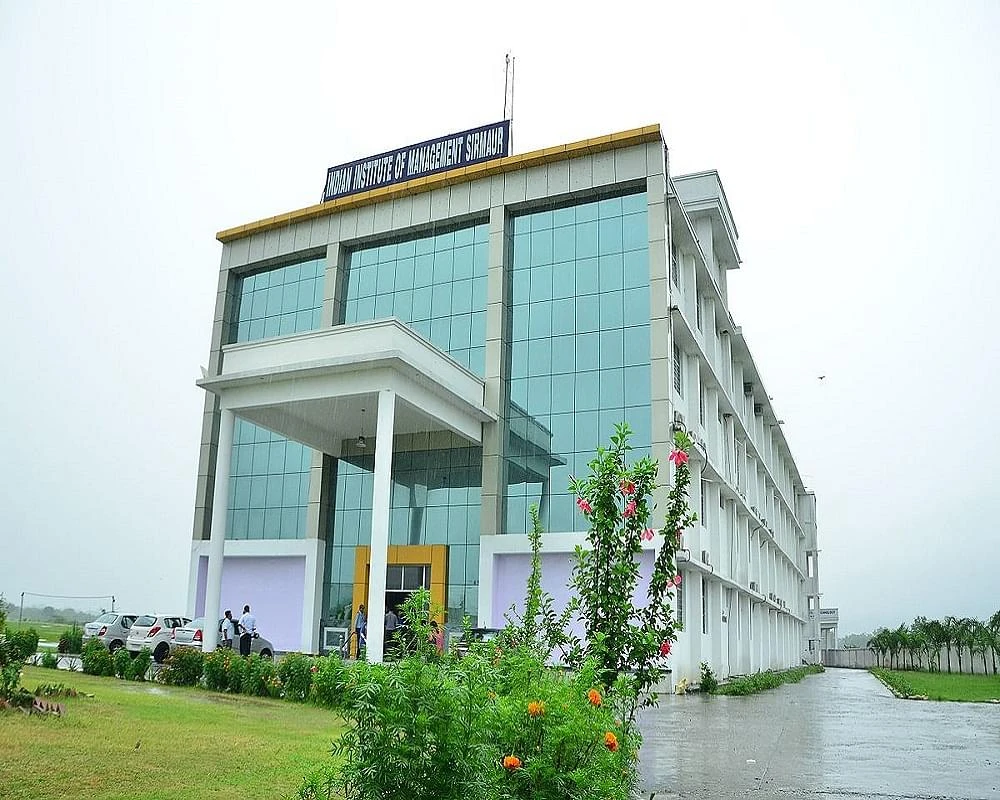


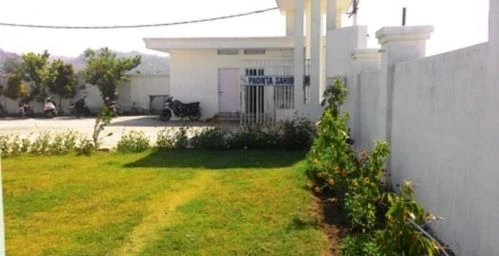
In this preview: 5 photos · 0 videos
Yes, IIM Sirmaur is considered worth it, especially noted for its transparency in placements and strong faculty. It is often ranked alongside peer institutions like IIM Amritsar and IIM Nagpur.
Placements for the Tourism MBA are specialized, with average packages slightly lower than the general MBA program, around 13.3 LPA. However, the roles offered are high-quality, particularly in consulting and hospitality sectors.
Yes, the permanent campus is ready. The MBA batches shifted to the new campus in Dhaula Kuan in July 2024. The Bachelor of Management Studies (BMS) program still operates partially from the older city campus in Paonta Sahib.
Shortlisting for the BMS program is based on the Aptitude Test Score (ATS) from the IPMAT Indore exam. A raw score of 175 or above is generally considered safe to receive an interview call.
Social life is largely student-driven with active clubs for Marketing, Finance, and Trekking. While not as bustling as city-based IIMs, the campus life features the annual fest 'Sierra' as a major highlight.
About IIM Sirmaur.
Colleges cannot rewrite published reviews. We remove spam and abuse.
Ask the communityWhat should future students know?
Tell us which course you're considering. We'll help you work out the next step.
Get instant Partner access after mobile verification. Your public edits are reviewed before they go live.
Claim this college
 Auditorium
 Cafeteria
 Campus Security
 Communication Centre
 Hostel
 Medical
 Sports Complex
 Study Library