
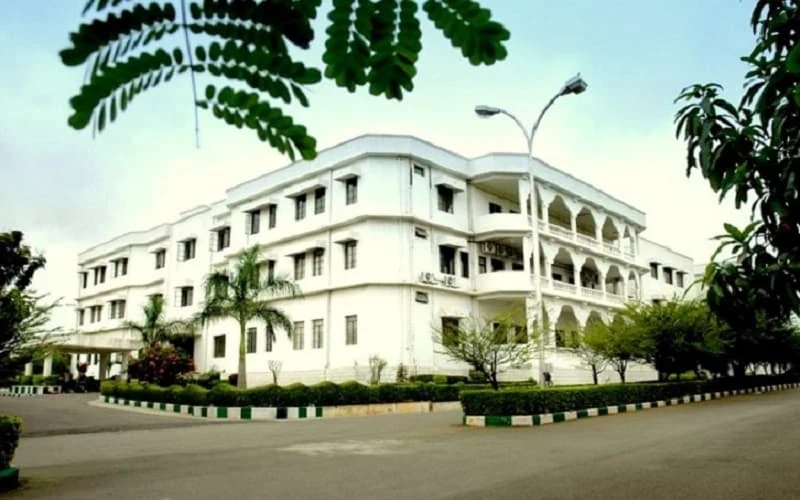

 Auditorium
 Bank & ATM
 Cafeteria
 Campus Security
 Campus Shuttle
 Campus Wi-Fi
 Communication Centre
 Computer Labs
 Gym
 Hostel
 Medical
 Science Labs
 Sports Complex
 Study Library
IIIT Hyderabad’s campus is designed around residential study, with teaching and research facilities, on-campus housing, dining, health services and recreation in one location. The practical trade-off is that the institute describes student residence as compulsory, so applicants should assess hostel life and the campus location as part of the programme choice rather than treating facilities as optional extras. The official facilities page covers multiple campus services, but it does not publish current accommodation charges, room-allocation guarantees or a student-facing accessibility inventory. Confirm those details with the institute before accepting an offer.
Study and research spaces
The institute lists air-conditioned computer laboratories, with access allocated batch-wise, and an intranet connecting campus buildings, including hostels. It also describes quiet student workspaces with discussion rooms and whiteboards, plus teaching laboratories with presentation equipment. These are useful distinctions for applicants: scheduled teaching labs, shared computer access and research computing are different resources, and the page does not promise that every student has an individually assigned workstation or unrestricted access to every specialist lab.
Research facilities include high-performance computing (HPC) services, specialist equipment in research centres and named laboratories in areas such as embedded systems, optical and RF work, and polymer research. The HPC material is directed at computational research. It should not be read as a guarantee that every undergraduate course or project receives a particular allocation. Applicants considering research-heavy study can ask the relevant programme or research group about eligibility, onboarding and availability for their project.
The library supports both physical and digital study. IIIT Hyderabad describes books, reference material, technical reports, journals, an online catalogue and a digital library; the separate library site also lists e-books, conference proceedings, journals and theses. A reading room and stack-area study space are noted on the infrastructure page. The combination should suit students who use print holdings, searchable digital material and quiet individual study, although opening hours, borrowing limits and seat availability should be checked with the library for the relevant term.
Residential life and location
IIIT Hyderabad describes itself as a residential institute and says students are required to stay on campus. The facilities page lists five hostels, three for men and two for women, with accommodation assigned by student group and year. It specifies shared rooms for first- and second-year bachelor’s and dual-degree students, and single occupancy from the third year onward. These statements are useful for planning, but applicants should confirm the assignment applicable to their own programme, including postgraduate and research categories, before relying on a room type.
The campus page gives its size as 66 acres and places it on Gachibowli Road, also called the Old Bombay Highway, in Hyderabad. It describes nearby academic and research institutions and access toward HiTech City and Lingampally. That is a location description, not a commute-time guarantee: travel depends on the destination, time of day and transport mode. If a student expects frequent off-campus travel, check the actual route and public transport options from the campus gate rather than assuming that “well connected” means a short daily journey.
For day-to-day convenience, the institute lists an SBI branch and ATM, a stationery shop and canteens. It reports 24-hour security at hostels, the main gate and academic and administrative buildings, with one entry and exit point. Those are institutional descriptions, not a substitute for checking visitor rules, late-night access procedures or personal safety needs with campus administration.
Food, health and recreation
The facilities page lists three mess services with different meal patterns and says students may register with a mess of their choice. It also identifies two campus canteens for snacks, beverages and light meals. This offers more than one dining format, but the page does not state current meal charges, menus, allergen controls or whether every option operates at all times. Students with dietary, religious or medical requirements should ask the mess office what can be accommodated and whether arrangements need advance notice.
For health support, the institute lists the Aarogya Centre for primary care, a nurse service, ambulance availability, outpatient and limited inpatient care, and counselling. Its page also describes referral access to nearby hospitals for emergency and laboratory services. These are useful campus-level supports, but applicants should not treat the clinic as a full hospital or assume that every specialty is available on demand. Confirm current clinic timings, emergency contact procedures, insurance requirements and referral arrangements before arrival, especially if ongoing care or medication is important.
Sports and recreation listings include outdoor courts and grounds, an open-air gym, an equipped gymnasium, table tennis, pool tables, chess and carrom, and a yoga hall. The institute also describes sports-credit courses, coaching and campus competitions. These options can help students build activity into a residential routine, though access may depend on scheduling, training or equipment availability. The campus page additionally names Tarangini as a cultural space with rooms for activities such as dance and music.
What to verify before accepting
The strongest fit is for a student comfortable with a residential campus and the academic rhythm of shared facilities. Before committing, ask admissions or the relevant hostel office for the current fee schedule, room-allocation rules for the exact programme, meal charges, medical escalation process, accessibility arrangements and the latest transport guidance. The published facilities material is a useful inventory, not a current cost sheet or service-level promise. No separate 2027-28 facilities changes or charges were identified in the sources reviewed, so the details above describe facilities listed by the institute as checked on 6 November 2026.