
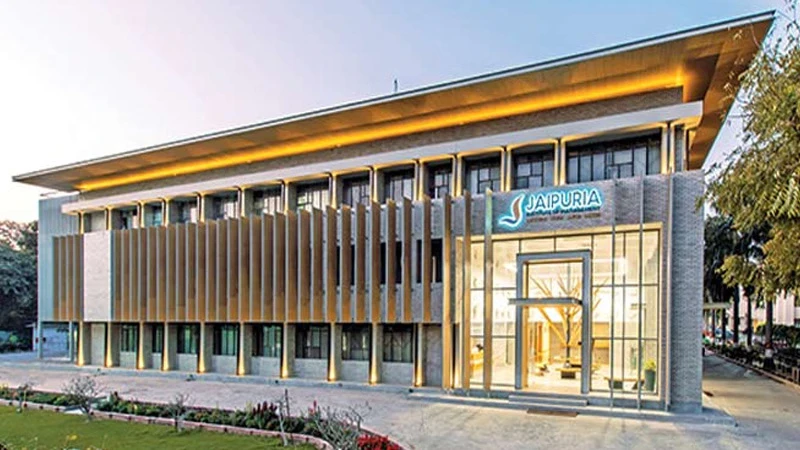


Jaipuria Institute of Management Lucknow placements: how to read the available data
Jaipuria Lucknow’s published outcome data comes from two different views. The campus-specific NIRF submission reports completed cohorts through 2024–25 for postgraduate two-year programmes. The institute placement page gives a newer 2024–26 update, but it combines four campuses and says the process is underway. The figures answer different questions; they should not be combined into one Lucknow placement rate or package claim.
Lucknow’s reported outcomes for postgraduate two-year programmes
The NIRF 2026 data submission for Lucknow reports graduates in minimum stipulated time, students placed, median salary in rupees and students selected for higher studies. It labels the group “PG [2 Years Program(s)]” and does not split outcomes by PGDM specialization. The reported series is:
The placed counts are close to, but not identical with, the counts graduating in minimum stipulated time. Dividing placed by graduates gives about 98.5%, 97.1% and 97.2%, respectively. These are simple ratios calculated from the submitted counts, not placement rates separately reported by the institute. The source does not explain whether every graduate was eligible for placement or how students pursuing higher study were treated. Use the ratios only to compare those two columns for those cohorts, not to forecast outcomes for a future intake.
The median is the middle salary among placed graduates in the reported group. It is not the average or highest salary, and it does not predict what an individual student will earn. The source reports the values in rupees; the lakh figures in the table are conversions of ₹864,000, ₹879,000 and ₹900,000. The rows do not state salary distribution, role-level outcomes, programme specialisation, or whether compensation is annual fixed pay or total CTC. Do not infer those details from the median alone. The filing is an institutional submission to NIRF; the year 2026 identifies its reporting edition and is not a 2026 ranking.
The newer placement page is group-wide and in progress
The institution’s placement page says that placements are actively underway across Lucknow, Noida, Jaipur and Indore. It displays “97% Placements Currently Stand,” a highest package of ₹24.11 LPA, 300+ participating companies, 1,100+ students placed and 140+ new recruiters. The page presents these as current activity figures while the process is underway. It does not give a Lucknow-only denominator, eligible-student count, completed-batch label for the headline percentage, or campus-wise split for the package and recruiter totals.
Treat this as a group-level progress update, not a final Lucknow cohort result. The 97% figure should not be combined with the campus-specific NIRF rows or restated as a completed outcome. The highest package is also a group-wide headline, not a median or typical salary. Applicants comparing campuses should request a Lucknow-only report that identifies the programme, batch, denominator and compensation basis.
Programme coverage and limits of comparison
The Lucknow programme list includes PGDM, PGDM (Financial Services), FPM and PGDM (Retail Management). The NIRF series here is labelled only PG [2 Years Program(s)]; it does not provide separate results for general PGDM, Financial Services or Retail Management. It should not be extended to the doctoral FPM programme. The newer group placement page also offers no Lucknow programme split. A figure for the broad two-year postgraduate group therefore cannot answer which specialization has the stronger reported outcomes.
Before treating an outcome as relevant to a particular course, ask for a report naming that programme and campus. Check whether it covers the full graduating class, only students seeking placement, or accepted offers; whether domestic and international placements are combined; and whether the count refers to students, offers or employers. For salary comparisons, ask whether the amount is annual fixed pay, total CTC, or another measure, and how variable pay or joining bonuses are treated. These definitions matter more than an unqualified headline.
Questions to ask before using placement figures
A useful campus-level report should identify the graduating batch and programme, students graduating, students eligible for placement, opt-outs or students pursuing higher study, students placed, and the date figures were finalized. For salary, ask for the median and the definition of compensation, then check whether it is annual and whether variable pay, bonuses and international offers are included. A highest package alone cannot describe a typical outcome.
The NIRF submission gives a defined historic baseline for Lucknow, while the institute page gives a newer but broader in-progress update. Neither source provides a final Lucknow-only 2024–26 result. Read the historical table only for its stated PG [2 Years Program(s)] scope. Use the current headline only with its four-campus and ongoing-status caveat, and confirm newer programme-specific figures with the campus before using them to make an enrolment or return-on-investment decision.
When a campus shares a newer report, compare like with like: the same graduating year, campus, programme and denominator. A rate based on students who registered for placement is different from one based on all graduates. A salary median among placed students excludes people with no offer, so it should be read alongside the number placed and the number eligible. If more than one offer can be recorded for a student, ask whether the report counts students or offers. The available sources do not define those details for the group-wide update. Keeping these questions explicit prevents a progress dashboard from being mistaken for a final campus result.