
 Auditorium
 Cafeteria
 Campus Shuttle
 Computer Labs
 Medical
 Science Labs
 Sports Complex
 Study Library
Student facilities on the Mysuru campus
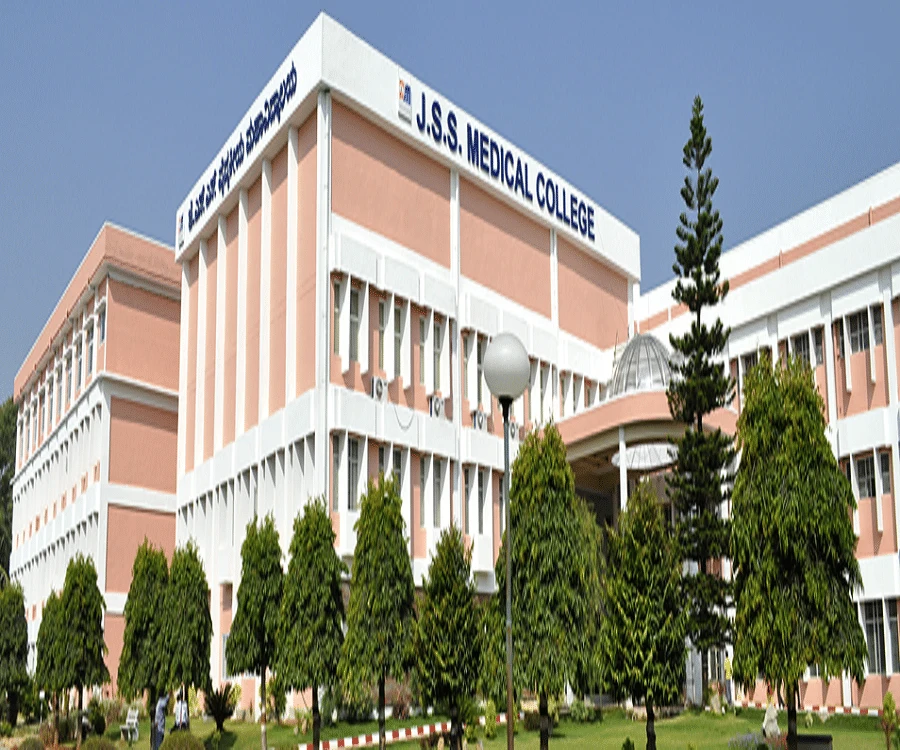
JSS Medical College’s facilities are part of a larger JSS Academy of Higher Education & Research setting in Mysuru. For a new student, the practical questions are whether daily services are close to the college, what accommodation is actually available, and which facilities are part of the medical college rather than another JSS institution.
The college lists a cafeteria and food court, a student support centre, computer-equipped teaching spaces, rooms with audiovisual equipment, printing services and coworking or meeting areas. The college facilities page also describes common rooms for students and a range of indoor and outdoor sports, including cricket, football, volleyball, basketball, badminton, table tennis and a gym hall. These listings show the types of spaces the college identifies; they do not confirm opening hours, charges, booking rules or access outside scheduled academic activity. Ask the college which spaces are operating for your current cohort and whether any are shared across the university.
The college’s hostel page describes separate accommodation for undergraduate men and women, with a separate arrangement for postgraduate students and residents outside the campus. It says students should apply using prescribed forms and lists pantry and laundry facilities, reading rooms, indoor and outdoor sports, security staff and CCTV. This does not confirm that a room will be available to every applicant, whether accommodation is compulsory, or what the current hostel, mess and deposit charges are. Get the current allotment policy and written fee schedule before including hostel costs in your budget.
JSS Medical College lists wheelchairs, ramps across college and hostel floors, suitable toilets and lifts among its accessibility provisions. A general list cannot establish that every teaching, clinical or residential space meets an individual access need. If you need a particular accommodation or route, ask the college to confirm the exact building, entrance, room and washroom access in writing and discuss the arrangements before accepting a seat.
Clinical skills, teaching spaces and library access
JSS AHER’s simulation-lab page lists forty types of adult and paediatric task trainers, alongside trainers for basic and advanced life support, surgical skills, laparoscopic and arthroscopic procedures, endoscopy, bronchoscopy and ultrasound. It also names high-fidelity adult, maternal and child simulators and simulated ICU, paediatric ICU and operating-theatre settings. This is a university simulation-lab description, so applicants should confirm which JSS Medical College courses use it, how sessions are scheduled and which skills are taught there before assuming that every item is available to every student.
Simulation is a practice setting, not a substitute for supervised patient care. For medical training, ask how simulation sessions fit into the curriculum, when students enter clinical placements, and which hospitals or departments provide each rotation. The college’s facilities page separately describes computer-equipped teaching spaces, audiovisual rooms and specialised laboratories. These details help distinguish classroom and skills infrastructure from clinical postings; they are not a promise about the number of sessions or individual access.
The dedicated JSS Medical College library page describes a medical-sciences collection, digital resources, a discovery service, group and private study areas, Wi-Fi, RFID, remote access and a hospital-library extension for clinicians, students and faculty. It also says a student identity card is used for access and that credentials for some resources are supplied by email. Confirm current borrowing rules, digital-resource access, hours and the exact entry procedure with the library, because its live service details can change. The page displays inconsistent collection figures in different sections, so this guide does not use a book count or seating total.
The medical-college facilities page also describes a body-donation programme used for MBBS teaching and postgraduate workshops, and a human cytogenetic laboratory. These are specific academic and research resources, not general-use student labs. Ask the department how they relate to your programme and at what stage students participate.
Health support and what to verify before joining
JSS AHER describes a health centre and community pharmacy on the JSS Medical Institutions campus. The listed services include outpatient care, first aid, blood-pressure and diabetes screening, basic life support, sample collection and common medicines. The page says patients needing advanced care are referred to JSS Hospital by ambulance. That is a primary-care description for students and staff across constituent colleges and university departments; it does not say that the centre provides round-the-clock emergency care or that every service is free. For urgent or specialist treatment, ask the university for the current referral process, timings, charges and emergency contact.
Before joining, request a current campus and hostel tour or a written facilities note from JSS Medical College. Confirm where teaching rooms, the library, simulation centre, health centre and hostel are located; whether their access is included in your programme; what costs extra; and which facilities have restricted hours or require booking. Students comparing medical colleges should also ask about clinical rotations and supervised patient contact rather than treating a simulator list as evidence of clinical exposure.
The source pages identify useful infrastructure, but they do not provide a current 2027–28 hostel vacancy list, hostel fee schedule, cafeteria prices, library access timetable, facility booking rules or a course-by-course map of simulation and clinical access. Confirm those points directly with the responsible college or university office and retain the written response alongside your admission documents.