
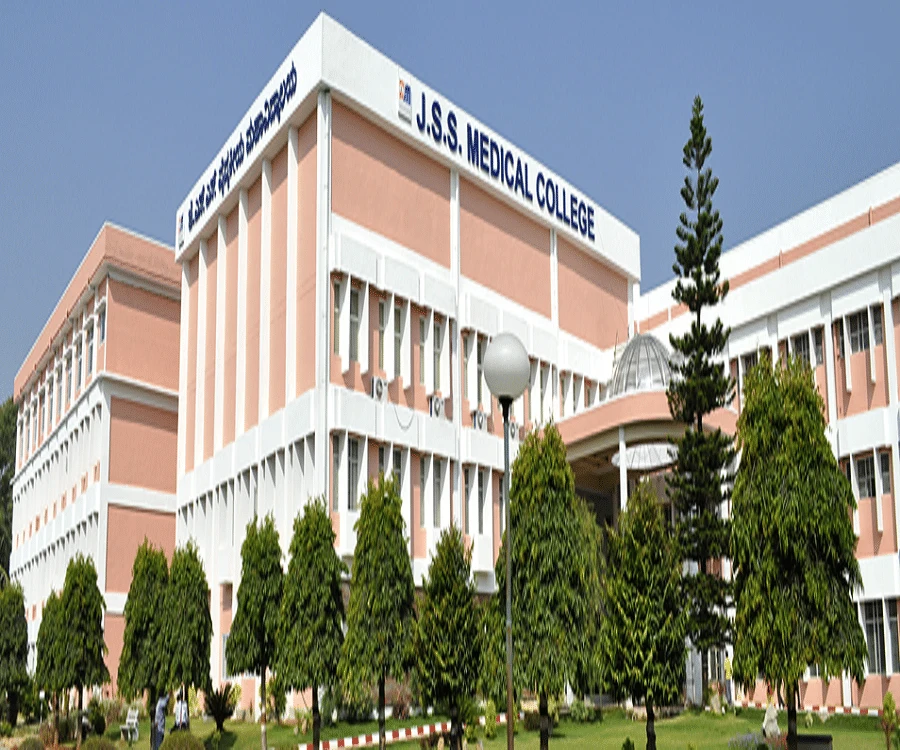

JSS Medical College Placements: NIRF 2026 Outcomes by Programme Group
JSS Medical College’s NIRF page links a 2026 data submission naming “JSS Medical College, Mysore [IR-D-C-35009].” The PDF reports placement and higher-study outcomes in three separate groups: undergraduate programmes of five years, postgraduate programmes of two years, and postgraduate programmes of three years. The rows cover graduating cohorts from 2021–22 through 2024–25, depending on group. They are historical outcomes submitted for NIRF 2026, not a current guarantee for 2027–28 students. The official NIRF 2026 submission is the source for the figures below.
The report’s “graduated in minimum stipulated time,” “placed,” “median salary of placed graduates,” and “selected for higher studies” columns measure different things. A median applies to the placed graduates in that row, not to every graduate. A higher-studies count is a separate reported destination and should not be added to the placed count as though it were a placement. The submission does not give employer names, specialty-wise destinations, job roles or a single institution-wide placement rate in these tables.
The UG five-year table reports three cohorts. For graduates in 2021–22, it lists 189 graduates in minimum time, 133 placed, a median salary of ₹13,00,000 among those placed and 56 selected for higher studies. For 2022–23, it lists 194 graduates, 129 placed, a median of ₹13,25,000 and 65 in higher studies. For 2023–24, it lists 198 graduates, 108 placed, a median of ₹18,24,000 and 90 in higher studies.
The source labels this group “UG [5 Years Program(s)].” It does not name individual undergraduate awards in the table, so the figures should stay attached to that broad group. In particular, do not treat the median as a starting salary for every graduate, as a guaranteed offer, or as a measure of each specialty. The 2023–24 median is higher than the two earlier entries, but three historical rows do not establish that future compensation will follow the same pattern.
The PG two-year rows are very small. For 2022–23 and 2023–24, the PDF reports one graduate and one placed graduate in each year, with medians of ₹75,000 and ₹80,000 respectively and zero selected for higher studies. For 2024–25, it reports zero graduates, zero placed, a zero in the source’s median column and zero higher studies. With no graduates or placed candidates in that final row, the zero is not a salary observation; a median is not meaningful for that cohort.
For the PG three-year group, the 2022–23 cohort has 140 graduates, 129 placed, a median of ₹18,60,000 and 11 selected for higher studies. The 2023–24 cohort has 140 graduates, 130 placed, a median of ₹19,10,000 and 10 in higher studies. For 2024–25, the report lists 144 graduates, 121 placed, a median of ₹22,33,200 and 13 selected for higher studies.
These are broad duration groups as labelled by the NIRF table; it does not break the figures out by medical specialty. The three-year postgraduate figures therefore cannot be assigned to one MD, MS or diploma specialty from this document alone.
Start by comparing the same programme group and graduation year. The UG five-year row is not directly comparable with the PG three-year row, and the PG two-year result is based on one graduate in each of its first two cohorts. Keep the denominator visible beside the placed count and read the median only with that same row. A median from one cohort does not say what an individual candidate will earn; the NIRF submission does not include job titles, employer mix, hours, location or specialty-level salaries in these tables.
The document is an institutional submission to the National Institutional Ranking Framework. It provides a defined reporting source and edition, but readers should not interpret it as an independently audited placement census unless a separate audit is produced. It also does not report placements for a 2027–28 graduating cohort. Students choosing a medical programme should weigh these historic figures alongside specialty training, licensing, postgraduate plans and clinical experience; none of those decisions is answered by a salary median alone.
For a current comparison, open the JSS Medical College NIRF data page, select the latest available submission, and confirm the college name and NIRF institute ID in the document before using any row. Keep its edition, group, cohort year, graduates, placed count and salary unit together. If a later PDF changes a row or reports a new category, compare the same source fields rather than extending the 2026 values forward.