

 Auditorium
 Cafeteria
 Campus Security
 Campus Wi-Fi
 Computer Labs
 Medical
 Science Labs
 Smart Classrooms
 Sports Complex
 Study Library
LBSIM campus facilities: study resources, events and housing
Lal Bahadur Shastri Institute of Management (LBSIM) is at Plot No. 11/7, Sector 11, Dwarka, New Delhi. Its official overview places the campus near the Sector 11 Metro Station on the Blue Line. The facilities most relevant to a student’s routine are its Learning Resource Centre (LRC), bookable group and e-learning rooms, auditorium and separate boys’ and girls’ hostels. The institute describes these features in separate pages; confirm operating hours, current access rules and hostel availability directly before planning around them.
Campus location and daily access
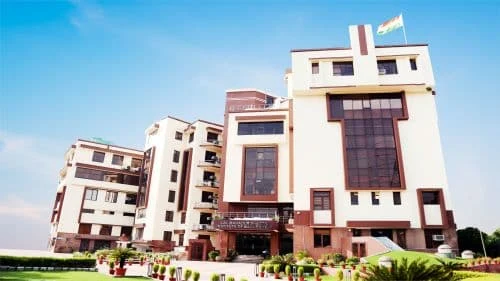
LBSIM’s official overview identifies the campus as being in Dwarka, New Delhi, near the Sector 11 Metro Station. It describes the main building as fully air-conditioned and the library as spanning two floors, and it also names an open-air theatre. These are campus-level details, not a guarantee that every room is open at all hours or that every event space can be used without booking. If commute time matters, check the route from the station entrance to your teaching space and the timetable for your own programme rather than relying on a general description of the area.
The location may suit students commuting from Delhi or elsewhere in the National Capital Region, while hostel residents have a different daily journey. LBSIM’s hostel page says it arranges transport between its hostels and campus. It does not publish a shuttle timetable in the source reviewed here. Ask about pickup points, frequency, service hours and what happens during late classes or institute events. Those details determine whether the listed distance is workable for your schedule.
Auditorium and campus events
The institute describes a centrally air-conditioned auditorium with seating for 300, an audiovisual setup, multifunctional lighting, a podium, wired and wireless microphones and a projector. Its page says the venue is used for national-level conferences, award ceremonies, seminars, cultural programmes, debates and presentations. That gives applicants a clear sense of the type of formal and student events hosted on campus, but it does not establish how often a particular cohort uses the room or whether student societies have open access.
LBSIM’s overview also mentions an open-air theatre, but the available campus description does not give a seating figure, booking process or regular event calendar for that space. If performance, debate or event production is important to you, ask which societies can reserve each venue, how far in advance bookings are made, and whether technical support or equipment is included. Treat the stated auditorium capacity as the venue’s maximum seating description, not as the size of a typical class or event audience.
Learning Resource Centre and digital access
The two-floor Learning Resource Centre is the main academic resource described in the official campus material. LBSIM says it uses the KOHA library-management system, smart cards, RFID gates, self check-in and check-out, and an OPAC kiosk. The page lists three syndicate rooms and four e-learning rooms, available by prior booking. Students who expect to work in teams should ask how long a booking lasts, whether rooms can be reserved for recurring project work and how availability changes during examinations.
LBSIM reports a collection of about 50,000 books, reports and other non-book materials, 90 print periodicals, and online access to more than 10,000 periodicals. Its page also names a dedicated Bloomberg Lab and access to electronic journal and reference databases. Among the listed resources are Business Source Ultimate, Emerald, Sage, ScienceDirect, Prowess-CMIE, CRISIL i360, Economic Outlook-CMIE, IndiaStat, ET Prime, Harvard Cases and Ivey Cases. Some named databases are marked as IP-based; other services require self-registration. The source does not give a student-by-student licence count, off-campus access rules or current availability for every resource. Confirm those details with the library before assuming that a database can be used from a personal device or outside campus.
The LRC page also says LBSIM is affiliated with DELNET and has access to more than 10,000 institutions through the network. This is a description of the network’s reach, not a claim that every item from those institutions is instantly deliverable. Ask librarians how inter-library access works, what can be requested and whether any service has a fee or wait time. The OPAC and library staff are the practical starting points for checking a specific book, journal or database.
Hostels and residential logistics
LBSIM describes separate air-conditioned residences for girls and boys. Its hostel page places the girls’ residence about 300 metres from campus and the boys’ residence about 3 kilometres away; it identifies Shastri Bhawan as a boys’ hostel inaugurated in June 2024. Rooms are twin-sharing, and the institute says it arranges transport between hostels and campus. The page describes furnished rooms, Wi-Fi, CCTV, wardens, housekeeping, common rooms, dining areas and an on-call doctor. It also lists a 24-hour warden and security arrangement, fire-safety equipment and power backup for electrical points other than air conditioners.
The same page specifies a monthly laundry allowance of 60 clothes for washing and ironing per student, with additional service chargeable. It describes four meals—breakfast, lunch, evening snacks and dinner—in the hostel dining hall. This is useful planning information, but it is not a substitute for checking the hostel contract, current menu, dietary arrangements, laundry counting rules or the charges in force for your admission batch. The site’s distance and amenity descriptions do not confirm that a room will be available to every admitted student.
What to verify before you choose
Compare the facilities with your own weekly routine. A student who plans to use the LRC for group projects should ask about booking access and opening hours; a student using digital databases should confirm which services work off campus and whether personal registration is needed. A commuter should check the actual metro-to-class route and class schedule. A hostel applicant should confirm room allocation, the current residence and transport arrangements, charges and refund terms with the institute. The facilities pages describe infrastructure and services, but they do not publish enough detail to settle every operational question.
For a visit, ask to see the LRC, a syndicate room, the auditorium and the relevant hostel before paying a deposit. Confirm which spaces are available to your programme, whether access is scheduled or open, and whom to contact when equipment or internet access fails. The useful comparison is not simply the number of facilities listed: it is whether the room, service and access rule you need will be available at the time you need it.