Loading Admission Guardian content
Loading Admission Guardian content

Explore the available options or ask for admission guidance.
Explore the available options or ask for admission guidance.
Lal Bahadur Shastri Institute of Management (LBSIM) is a specialist management institute in Dwarka, New Delhi. Its current full-time portfolio is built around two-year PGDM programmes, with separate tracks in general management, finance, research and business analytics, e-business, and artificial intelligence and data science. The practical question for an applicant is therefore not simply whether LBSIM is a “good B-school”: it is whether one of these specific programmes, its entrance route and total cost, and the institute’s reported outcomes fit the applicant’s goals.
For the 2027–29 cohort, the institute’s admissions page lists CAT 2026 as the primary score route, alongside XAT 2027 and GMAT. It asks for a bachelor’s degree with at least 50% from a recognised university. The process includes composite shortlisting, an extempore exercise and a personal interview. LBSIM says programme cutoffs vary and are announced each cycle, so old percentile estimates should not be treated as a current guarantee. Applicants should verify dates, programme eligibility and the live application instructions on the official admissions page before applying.
This is a compact overview rather than a substitute for the detailed admission guide and courses and fees guide, which should be checked for the current programme-level rules and cost components.
LBSIM’s current portfolio includes PGDM (General), PGDM (Financial Management), PGDM (Research & Business Analytics), PGDM (E-Business), and PGDM (Artificial Intelligence & Data Science). These are distinct two-year, full-time programmes, not specialisations that should be assumed to share identical admission thresholds, fees or placement outcomes. The General PGDM page reports 180 seats for that programme; this should not be read as the combined intake across all five programmes.
The General PGDM page describes the programme as AIU-equivalent to an MBA. LBSIM also says four PGDM programmes are NBA-accredited, but the captured excerpt does not name all four; equivalence, accreditation and a university MBA degree are different descriptions, so applicants comparing qualifications should retain the exact award wording and confirm the programme-specific accreditation. The institute’s own page reports AIU equivalence for General, Financial Management and Research & Business Analytics. Do not automatically extend that equivalence statement to E-Business or AI & DS without checking the applicable programme page and current recognition record.
The portfolio allows applicants to compare a broad management course with more focused routes. Finance, analytics, digital commerce and AI/data science are named programme choices, but a programme title by itself does not establish curriculum depth, recruiter fit or the applicant’s likely role after graduation. Read the course structure and eligibility for the particular programme, then compare it with the work the applicant wants to do. The published placement report also presents programme-wise averages; those historical averages can inform comparison, but they are not a promise of an individual outcome.
LBSIM’s official admissions page identifies the 2027–29 intake and accepts a valid CAT 2026, XAT 2027 or GMAT score. It names CAT 2026 as the primary route. The published minimum academic eligibility is a bachelor’s degree with at least 50% from a recognised university. Applicants should check the official page for any category-specific conditions, final-year rules, document requirements and programme exceptions before submitting an application; this overview does not infer unlisted waivers.
The selection sequence described by the institute is application and entrance-score submission, composite shortlisting, followed by an extempore and personal interview. Shortlisted candidates attend at the Delhi campus. Because LBSIM says cutoffs are programme-specific and announced each cycle, a percentile seen in an older article or coaching estimate is not an official cutoff for this intake. The available official FAQ likewise says the score cutoff varies from year to year. A candidate near a previous cutoff should apply only after checking the current programme page and should not treat a past call-getter range as a prediction.
Application fees and dates can change within a cycle. On the captured official programme page, the 2027–29 General PGDM application fee is ₹1,500 through 15 November 2026 and ₹2,200 from 16 November 2026. Those are date-bounded figures from that page, not a claim about every programme or a later cycle. Check the live application portal for the amount due when applying. For current test editions and process details, use LBSIM’s official admissions page, not an undated third-party summary.
For the General PGDM 2027–29 batch, LBSIM lists headline tuition of ₹17.25 lakh for general candidates and ₹22.90 lakh for corporate-sponsored candidates. The same schedule lists additional charges: ₹25,000 for the compulsory immersion, ₹10,000 refundable security, ₹15,000 examination charges, ₹50,000 Management Grid and ₹15,000 alumni charges. The international immersion is optional and its actual expenses vary. These components should be read separately; tuition alone is not the full amount payable under the schedule.
Hostel charges are stated separately from the programme tuition. The published schedule lists ₹2.40 lakh for 2027–28 and ₹2.00 lakh for 2028–29, plus a refundable ₹10,000 deposit. Hostel accommodation and its fees are therefore a separate budget line, and the figures should not be rolled into tuition without specifying what is included. The institute’s hostel page describes separate residences for women and men, with different distances from campus; applicants should confirm availability, allocation and current charges directly.
The figures above are the General PGDM schedule captured for the 2027–29 batch. Do not apply them automatically to the other PGDM programmes, to a corporate-sponsored seat, or to a later intake. The institute’s programme and fee information is the responsible source for the schedule; the detailed fees guide separates programme tuition, other charges and hostel costs. Before accepting an offer, ask the admissions office for a complete payable schedule, refund rules and any financing or scholarship conditions in writing.
The latest official placement report captured for this overview covers the 2024–26 batch and says placements were still underway to ensure full placements. It reports 85+ recruiters, including 27 new recruiters, a highest package of ₹24.00 lakh per annum and an average for the entire batch of ₹12.32 lakh per annum. It also reports the top 10%, top 25% and top 50% average packages as ₹16.13 lakh, ₹14.19 lakh and ₹13.11 lakh respectively, plus 38 PPO/PPI outcomes. Because the report describes the process as in progress, these are provisional reported figures, not a completed batch result or a confirmed 100% placement rate.
The same report gives programme-wise averages: ₹12.4 lakh for General, ₹12.5 lakh for Financial Management, ₹12.2 lakh for Research & Business Analytics, ₹12.0 lakh for E-Business, and ₹12.1 lakh for AI & DS. These are averages reported by the institute for its 2024–26 batch; the page does not make them an individual salary forecast. Applicants should compare them with the report’s other distribution points, especially the top-half and top-quarter averages, and ask for the number of students included in each programme-wise denominator if that information matters to their decision.
An average can be pulled upward by a smaller number of high offers. LBSIM’s report gives multiple distribution measures, which makes it more useful to read the average alongside the top-half and top-quarter figures rather than in isolation. The highest package is an upper-end observation, not a typical offer. The captured report does not establish a median for this batch, so this overview does not invent one. Recruiter counts also do not show how many students received offers from each employer, what roles were offered or whether every student’s preferred sector was represented.
The report names a broad recruiter pool and programme-specific averages, but the right comparison depends on the applicant’s target role and prior experience. Ask for a final report once the placement process closes, with the batch denominator, programme-wise placed and eligible counts, compensation definitions, fixed-versus-variable components and role distribution. For internships, verify the separate summer-placement report and its period; do not mix an internship stipend with a final placement salary. The institution’s placement report is the source for the 2024–26 figures summarised here.
LBSIM’s NIRF page displays the Management category band 101–125 for the 2025 edition. A band is not an exact rank. The page also links the official ranking record and report; readers comparing institutions should open those documents and compare the same category and edition. This is a dated result, not a current ranking for future years.
LBSIM’s own broader ranking page lists media-specific results for 2024: Times of India, January 2024, rank 6 overall and 3 among private institutions; IIRF, June 2024, rank 20 among private institutions; Business Today, September 2024, rank 32 overall and 18 among private institutions; Outlook, October 2024, rank 14 among private institutions; The Week, November 2024, rank 15 among private institutions; Business World, December 2024, rank 19; and Fortune India, December 2024, rank 13. These are different publishers, methodologies and categories. They should be presented as separate dated results, not combined into one league position or described as a 2025 result merely because the institutional page covers multiple years.
For recognition, distinguish the programme’s award from accreditation. The General PGDM page reports AIU equivalence to an MBA for specified programmes and states that the four PGDM programmes it names are NBA-accredited. Applicants should verify the exact programme and recognition period from the responsible page and regulator or accreditor before relying on a label for employment, higher study or a credential evaluation.
LBSIM’s student-welfare page says it awards 15 merit-cum-means scholarships of ₹1 lakh each to first- and second-year students enrolled in PGDM programmes. A director-appointed committee selects recipients. The page also lists the Lalita Shastri Award and Amit Chopra Award, but the available extract does not provide their current eligibility, value or intake-specific rules. Applicants should ask the institute how the 15 awards are allocated between years and programmes, what financial documents are required, whether a recipient must maintain academic standing, and when applications are considered. Do not subtract a scholarship from the published fee total unless the student has a confirmed award.
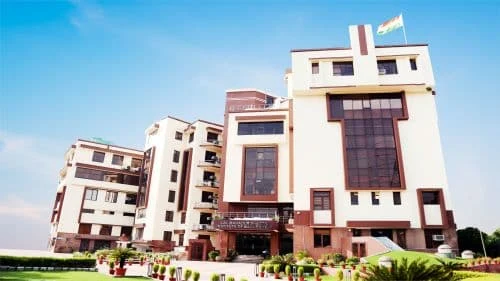
LBSIM’s campus is in Dwarka, New Delhi, close to the Sector 11 Metro station. The official overview describes a fully air-conditioned building, an auditorium with capacity for 300, a two-floor library and an open-air theatre. The auditorium page lists audiovisual equipment and says the space is used for conferences, seminars, cultural programmes, debates and presentations. These are useful facilities for classes and events, but they do not turn a compact urban institute into a large residential university campus.
The Learning Resource Centre uses KOHA, smart cards, RFID, self-service check-in and check-out, an OPAC kiosk and RFID gates. The institute reports approximately 50,000 print and non-book items, 90 print periodicals, online access to more than 10,000 periodicals, three syndicate rooms and four e-learning rooms. A Bloomberg Lab and digital resources are also listed. Ask whether any specialist terminal or database requires a separate course, booking or access arrangement; the presence of a lab does not establish that every student has unrestricted access at all times.
LBSIM describes separate air-conditioned residences for men and women. Its hostel page places the women’s residence about 300 metres from campus and the men’s residence about 3 kilometres away, and says Shastri Bhawan was inaugurated in June 2024. The page lists twin-sharing rooms, institute transport, Wi-Fi, CCTV, housekeeping, laundry allowance, an on-call doctor, wardens, dining and common rooms. Those details describe the listed facilities, not a guarantee of a room for every admitted student. Confirm allocation, transport schedule, current hostel charges, meal arrangements and any rules that matter to you before paying a deposit.
The campus trade-off is practical: central access within Dwarka and a defined set of academic resources, paired with a compact site and separate hostel residences. Applicants who prioritise a large, self-contained campus should visit or request a current campus map and residence information rather than assume the institute has a conventional residential-university layout. The institute’s overview, library and hostel page describe these facilities.
LBSIM may merit a closer look for applicants seeking a full-time management programme in Delhi and a choice among general management, finance, analytics, e-business and AI/data-science tracks. The 2027–29 admissions route is clear enough to plan around: CAT 2026 is primary, while XAT 2027 and GMAT are also listed. The institute publishes a batch-specific fee schedule, multiple placement distribution measures and detailed campus-resources pages. Those are useful starting points for comparing options.
The evidence also has limits. The latest captured placement report is still in progress; it does not support a completed-placement claim or a median salary for the batch. Cutoffs vary by programme and cycle and are not specified as fixed numbers in the official admissions page. Fee and hostel costs differ by programme or candidate category and must be checked against the exact offer. Rankings belong to named publishers and editions, not to an undated overall status. Scholarship awards are limited in count and require selection.
A sensible shortlist process is to compare the precise programme and qualification, confirm the current cycle’s eligibility and score route, calculate tuition plus compulsory charges and housing, then review final placement data with its denominator and status. Ask admissions for unresolved details in writing and keep the response with the offer documents. LBSIM’s published information can answer much of the initial comparison, but it should not replace programme-specific confirmation before a financial commitment.
Selected ranking categories, with the recorded year beside each result. Open all records for the complete history.
54 published records · Lower numeric ranks are stronger
Outlook
Management · private
#132023
IIRF
Management · private
#192024
IIRF
MBA · private
#202024
Outlook
MBA · private
#142023
TOI
MBA
#62024
Find a program, read its fee details and explore the admission requirements.
Summary of the programs shown below. See each program's fee period below.
Eligibility: Post Graduation with 60%
Specializations
Listed entrance exams
Eligibility: Graduation
Specializations
Listed entrance exams
Eligibility: Graduation with 50%
2 exams with cutoff data available - showing recent entries
 Accenture
 Asian Paints
 Bain & Company India Private Limited
 Barclays Bank
 Bata
 Britannia Industries
 Byju's
 Capgemini
 Cians Analytics
 Cognizant
 Cvent India Pvt. Ltd
 Darashaw
 Delhivery
 Deloitte
 Ernst & Young
 EY Consulting
 Gartner Inc
 Havells
 HCL Technologies
 HDFC Bank
 Hindware
 Hitachi consulting
 ICICI Lombard
 Infoedge
 Infosys
 Jaro Education
 JK Tyre
 Kotak Mahindra Bank
 KPMG
 Lenskart
 Mahindra & Mahindra
 Mahindra Logistics
 MakeMyTrip India Pvt. Ltd.
 Marico Industries Ltd.
 Marsh India Insurance Brokers Pvt. Ltd.
 Maruti Suzuki
 Mazars
 Moody's Analytics
 PayU
 PhonePe
 Publicis Sapient
 PWC
 Razorpay
 RBL Bank
 Schindler Ltd.
 Schneider Electric
 TCS
 Tech Mahindra
 TVS Electronics
 Vivo
 Volvo Eicher
 Wipro
 ZS Associates
No, LBSIM does not accept CMAT scores for its PGDM programs. The institute only considers CAT, XAT, and GMAT scores for admission.
While the official website may state a lower figure, the actual CAT percentile required to receive an admission call for the General PGDM program typically hovers around 83 to 85 percentile or higher.
The choice depends on specialization. LBSIM is generally considered stronger for Finance, while FORE School of Management is often seen as superior for Marketing. LBSIM is also noted for having a slightly more disciplined academic culture.
Yes, hostel stay is mandatory for outstation students. However, students who are residents of the Delhi-NCR region can apply for an exemption from this requirement.
The Bloomberg Lab is famous for providing students with access to real-time financial market data used by professional traders. LBSIM integrates this platform into its Financial Management curriculum and offers students the opportunity to earn a "Bloomberg Market Concepts" certification.
About LBSIM.
Colleges cannot rewrite published reviews. We remove spam and abuse.
Ask the communityWhat should future students know?
Tell us which course you're considering. We'll help you work out the next step.
Get instant Partner access after mobile verification. Your public edits are reviewed before they go live.
Claim this college
 Auditorium
 Cafeteria
 Campus Security
 Campus Wi-Fi
 Computer Labs
 Medical
 Science Labs
 Smart Classrooms
 Sports Complex
 Study Library