
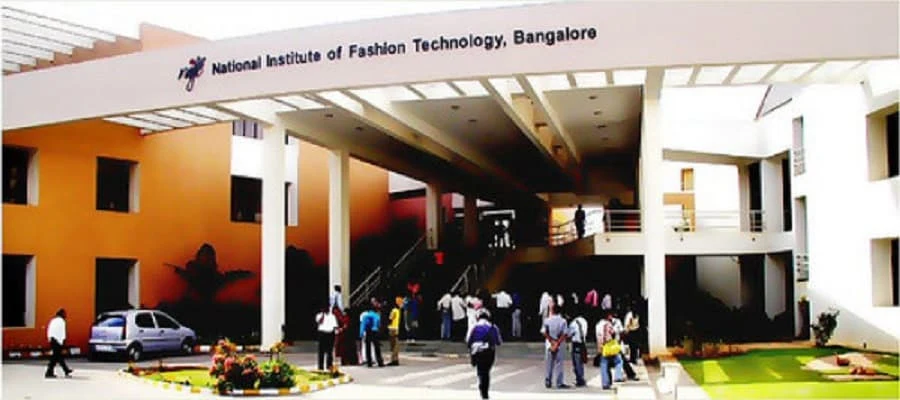

NIFT Bengaluru and the 2027 admission cycle
The Bengaluru campus is one of NIFT’s 20 campuses. Its 2027 prospectus identifies Bengaluru separately in the regular seat table and lists 304 regular seats across the campus’s programmes. That is an aggregate, not a promise of 304 places in any one course or category; the programme, reservation and domicile columns determine the actual seat pool. NIFT can revise course availability or seat numbers. The 2027–28 prospectus and NIFTEE 2027 bulletin are the governing documents for this cycle, while the campus website is useful for checking the Bengaluru programme list.
NIFT Bengaluru lists six undergraduate programmes: B.Des in Accessory Design, Fashion Communication, Fashion Design, Knitwear Design and Textile Design, and B.F.Tech in Apparel Production. Its listed postgraduate programmes are M.Des and Master of Fashion Management (M.F.M.). This distinction matters: the design bachelor’s routes include the Creative Ability Test (CAT), whereas B.F.Tech is assessed through the General Ability Test (GAT). A course appearing in another NIFT campus list does not establish that it is offered in Bengaluru. Check the Bengaluru programme page and the 2027 seat matrix before ranking campus choices.
Choose the eligible programme before filling the form
For the 2027 intake, B.Des applicants need a recognized 10+2 qualification, or one of the prospectus’s recognized equivalent routes, including qualifying NIOS study or specified diplomas after Class 10. B.F.Tech requires Mathematics at 10+2 level, including the stated NIOS subject combination, or the qualifying engineering diploma route. The prospectus sets an undergraduate age limit of under 24 years on 1 August 2027, with a five-year relaxation for SC, ST, PwD/PwBD applicants as specified in the notice. Do not assume the relaxation applies without the required category documentation.
For M.Des and M.F.M., the prospectus accepts a recognized undergraduate degree or the stated NIFT/NID diploma route. M.F.Tech has a narrower technical eligibility path: the bulletin lists a relevant B.F.Tech, B.E. or B.Tech qualification. Postgraduate applicants have no age limit under the 2027 rules. Read the programme-specific row rather than relying on a general statement that any graduate can apply, especially for M.F.Tech. The official prospectus controls how equivalent qualifications are treated.
NIFT’s entrance route is programme-specific. B.Des has GAT, CAT and a Situation Test after shortlisting; B.F.Tech uses GAT, including its two sections. M.Des combines GAT, CAT and a personal interview. M.F.M. uses GAT sections and a personal interview; M.F.Tech uses GAT and an interview. The bulletin sets the stage weights separately for each programme. Applicants should prepare for the components attached to their chosen course, not a single common NIFT paper.
NIFTEE 2027: test format and selection stages
NIFTEE 2027 uses a computer-based GAT and a paper-based CAT. For B.Des, the stated final selection weights are GAT 30%, CAT 50% and Situation Test 20%. For B.F.Tech, GAT Section A contributes 30% and Section B 70%. M.Des uses GAT 30%, CAT 40% and interview 30%. M.F.M. uses GAT 70% and interview 30%; M.F.Tech uses GAT 70% and interview 30%. These are not interchangeable routes: a strong score in a component not required for a programme does not replace its specified test.
The NIFTEE bulletin’s schedule is marked tentative. It gives 10 January 2027 for the examination, with GAT in CBT mode and CAT in PBT mode. It places the Stage 1 result in February/March, later assessment stages in March/April, and seat allocation in May/June 2027. Treat those later windows as planning estimates until NIFT or NTA publishes a revised notice. NTA handles registration, examination, answer keys and results/scorecards; NIFT conducts the admission and counselling process. Use the NTA NIFTEE page for exam notices and NIFT’s admission page for counselling updates.
Application form, fee and deadlines
The NIFTEE 2027 bulletin opened applications on 16 October 2026. The standard application deadline is 16 November 2026; late submission is allowed through 21 November with an additional ₹5,000 late fee. The correction window is 22–25 November. Since this guide is dated 7 November 2026, the regular-fee window remains open, but applicants should confirm the live portal before paying. A published schedule can be amended.
Application fee and submission steps
The application fee depends on category and whether one or two programmes are selected. For one programme, the bulletin lists ₹2,000 for Open, Open-EWS and OBC (NCL) applicants and ₹500 for SC, ST and PwD/PwBD applicants. For the permitted two-programme combinations, it lists ₹3,000 and ₹750 respectively. The stated NRI/Foreign/OCI/PIO/SAARC fee for UG or PG applications is ₹11,100. Payment service charges and GST are extra, and the fee is non-refundable except for duplicate payment. Check the bulletin’s pairing rules before using the two-programme fee; it is not a general discount for any arbitrary pair.
Complete the NIFTEE form on the official portal, select only eligible programmes, enter the examination preferences requested, upload documents in the prescribed format, and retain the final submitted form and payment receipt. NTA lists registration and test administration; NIFT is responsible for counselling and admission decisions. Do not treat an examination city as a campus preference. Bengaluru placement in the counselling preference list is a separate decision from the test-centre selection.
From score to a Bengaluru seat
The prospectus provides a 2027 Bengaluru regular-seat total of 304 across programmes and separately describes category and domicile allocation. NIFT also lists supernumerary NRI seats by programme for Bengaluru, but those are a separate route with their own eligibility and fee schedule. Do not add these places to the 304 regular-seat total when estimating the regular pool. The prospectus says seat availability may change at NIFT’s discretion.
After the relevant test and any subsequent stage, candidates must follow NIFT’s counselling and seat-allocation notices. A qualifying score is not an allotment. Compare Bengaluru’s actual programme seats and applicable category/domicile pool in the published matrix, then submit campus and programme preferences only through the current NIFT counselling instructions. The campus page confirms the programme list, but the prospectus seat matrix is the source for 2027 availability. No campus-specific cutoff or guaranteed admission threshold is established by these documents.
A practical application check
- Match your qualification to the exact B.Des, B.F.Tech, M.Des, M.F.M. or M.F.Tech eligibility row. For B.F.Tech, verify Mathematics; for M.F.Tech, verify the technical degree requirement.
- Check the age calculation date and any documented relaxation before submitting a UG application.
- Confirm which test components and later assessment stages apply to your chosen programme, and note the tentative January examination date.
- Submit before 16 November to avoid the late fee, or use the published late window only if the portal remains open through 21 November. Keep the confirmation page and receipt.
- Monitor NTA for examination notices and NIFT for counselling, seat matrix changes and campus allocation. Confirm Bengaluru programme availability in the current matrix rather than assuming the 2027 list cannot change.
The 2027 prospectus gives the rules and fee schedule; the NIFT admissions page and NTA NIFTEE portal provide the operational notices. If an equivalent qualification, category certificate or programme pairing is unclear, seek written clarification from NIFT before paying. The reviewed official documents do not publish a Bengaluru-specific guaranteed score, and later counselling movement should not be guessed from a previous year’s cutoff.