
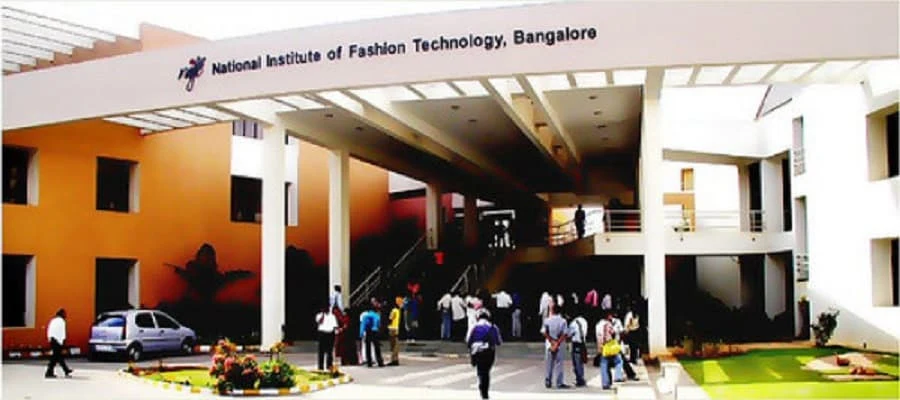

What NIFT reported for Bengaluru in 2025
NIFT’s 2024–25 annual report places the Bengaluru campus placement account in the Bengaluru campus section. It says the Bengaluru-centre campus event ran from 5 to 7 May 2025, with online placements scheduled from 13 to 16 May. Its table separates an event held for postgraduate students from one held for undergraduates:
These are dated event figures, not a 2027 placement forecast. The table labels the registration column as students registered “at Bengaluru campus” and its placed-count column “PG & UG”; it does not say that each row’s placement number is a PG-only or UG-only count, and it does not define a graduating-student or eligible-candidate denominator. The 923 and 2,755 registrations therefore should not be converted into placement rates. The report also lists employers including Increff, Narrative Arc, Textile Genesis, Arvind, Ciel Textile, Infoedge, Cultfit, RBZ Jewellers, Black Mango Fashions and Decathlon. It presents these as participants in the campus placement, not as recruiters for every programme or every student. The report gives no employer-by-programme count, salary-by-employer data or number of offers made by each company. A name in the participant list is evidence of a campus event, not proof that the company recruited from every Bengaluru specialisation. Applicants seeking an outcome for one discipline should request a programme-specific placement record instead of treating the campus-wide list as a course-level result. Read NIFT’s 2024–25 annual report and its Bengaluru annual-report index.
How the campus figures fit NIFT’s placement process
NIFT’s current 2026 placement page describes a centralised model in which companies can recruit across campuses and programmes. It distinguishes pre-placement offers from Phase I on-campus recruitment at designated campuses and Phase II online placements. That national process context matters: an employer or process described on NIFT’s central page is not, by itself, evidence that a particular Bengaluru programme had an offer or a specific outcome. The 2024–25 Bengaluru report is the responsible source for the campus event figures above; the current central page explains how NIFT presents its process, not Bengaluru’s current salary or placement rate. See NIFT’s 2026 placement-process page.
The report gives a second set of totals
Immediately after the table, the same annual report says 38 students received pre-placement offers (12 PG and 26 UG) and 59 were placed through Phase I and II (21 PG and 38 UG). Those totals do not match the table’s 19 plus 68 placed entries. The report does not explain whether the lines describe different phases, populations or counting dates, so this page retains both statements rather than selecting one as the “true” total. For a decision, treat them as two differently worded report figures and ask NIFT for the underlying cohort definition before comparing them with another campus or year. The source table and following sentence appear together in the Bengaluru section of the annual report.
CTC and salary figures: what is missing
The Bengaluru table has a “Highest & Lowest CTC” column and prints “9.8 - 6” for the PG event and “9.8 - 5.4” for the UG event. The table does not label the currency, whether values are rupees or lakhs, whether they are annual, or what pay components CTC includes. Those numbers are therefore not converted into ₹ lakh per year, and they should not be compared with median salaries from NIRF or another report. The annual report also does not provide a programme-wise median, average, placement percentage or full eligible-graduate count in this table. Until NIFT supplies a clearly defined unit and cohort basis, salary comparisons remain unknown. The annual-report table is the source for the displayed CTC text.
How applicants should use these figures
For a Bengaluru applicant, the report is useful as evidence that NIFT conducted separate PG and UG offline events in May 2025 and reported company counts and placements for those events. It cannot show the likelihood of an individual offer. Programme, graduating batch, eligibility, participation, offer acceptance and later online recruitment can affect who appears in a campus report; those details are not all supplied here. The report’s company examples can help you identify sectors that participated in that event, but they are not a promise that the same companies will visit next year.
When comparing outcomes, check four items before treating figures as comparable: the campus; the programme or programme group; the graduating cohort and period; and the definition of “registered,” “placed,” or “offer.” Ask for median and average salary separately, the compensation unit and annual basis, the eligible and placed headcounts, and whether later phases or PPOs are included. NIFT’s 2026 central process page explains that online and on-campus routes coexist, so a campus event table may not describe every placement route. Keep the 2024–25 data historical while planning for 2027–28; consult a later NIFT report when it supplies a comparable Bengaluru cohort.