Loading Admission Guardian content
Loading Admission Guardian content

3 programmes · 1 institution. Check the admission year and requirements.
3 programmes · 1 institution. Check the admission year and requirements.
First-year fee
Showing 5 courses
Specializations
Eligibility: Post Graduation
Specializations
Eligibility: Graduation
Specializations
Specializations
Listed entrance exams
Eligibility: Graduation with 50% + CAT
Specializations
Eligibility: 10+2
See courses and fees at other colleges.
Explore collegesLoading programmes and admission routes.
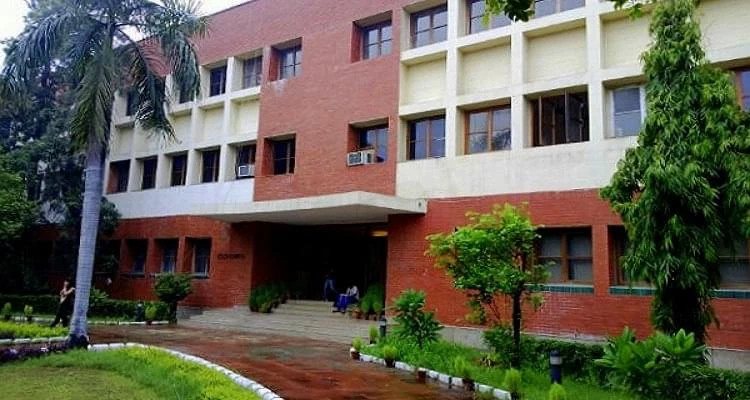
The Delhi School of Economics (DSE) campus is home to several University of Delhi academic units, so “DSE fees” is not one unified amount. The School’s constituent departments are Economics, Geography and Sociology. The Department of Commerce, part of the University’s Faculty of Commerce and Business, also operates at the DSE campus and runs MBA (Business Analytics), MBA (International Business) and MBA (Human Resource Development). The programme, administering unit and academic year must be identified before comparing a fee.
The captured official evidence does not support repeating the fee totals in the older article. The Faculty of Commerce and Business notice page lists a revised MBA fee-structure notice for 2026-27 onward, but its linked schedule was not extractable in this research record. Numeric amounts for the MBA programmes, application charges and foreign-student fees are therefore left out. The University and departments may list separate tuition, facilities, student-service, examination or other charges, and the exact payable total should come from the current programme notice. Do not use an old fee table as a budget for a new batch.
For two-year postgraduate programmes covered by the University of Delhi's 2026-27 CSAS(PG) bulletin, applicants also need to distinguish admission requirements from costs: the bulletin establishes the CUET(PG)-2026 plus CSAS(PG)-2026 route, not a single DSE-wide fee schedule. Check the programme's current prospectus and University fee notice together before accepting an offer.
The Department of Commerce’s three MBAs are full-time, two-year degrees across four semesters, but their academic direction differs. MBA (International Business) includes international trade, marketing, finance, supply-chain logistics and cross-cultural management. It is a relevant course structure for someone interested in cross-border business, trade operations or global market roles; the degree title itself does not guarantee an international job.
MBA (Human Resource Development) focuses on people and organisational work. Its published course list covers HR development, organisational behaviour, HR information systems, performance and talent management, labour law, industrial relations, compensation, HR analytics and strategy. Applicants should compare those subjects with the kind of work they want, including whether they prefer employee relations, people analytics, talent development or broader business management.
MBA (Business Analytics) combines a management degree with analytics subjects. The programme site describes a four-semester, 112-credit course structure, including core and elective study and opportunities for an internship, live projects and a capstone. It lists work involving Python and R, AI/ML, big data and visualisation. The value of this route depends on the applicant's interest in quantitative and data-oriented business problems, not on a claim that any one tool or placement outcome is assured.
DSE's constituent departments provide different postgraduate routes. The Department of Economics describes advanced study with theoretical and quantitative emphasis and empirical applications. Geography lists a two-year M.A. programme as well as doctoral study, spanning human and physical geography. Sociology is also a constituent department. Exact current course lists, electives and fee components should be checked against the relevant department's syllabus and University bulletin; an old article's combined list may conflate programme availability or eligibility.
Ask for the current fee document for the exact course and batch. Confirm whether the displayed figure is annual or total, whether it includes University and department charges, and whether examination, student-service or refundable deposits are separate. Check payment dates and refund terms in the offer notice. If the published MBA notice applies from 2026-27 onward, confirm that it covers the intended admission year and the specific MBA specialisation. The available captured page establishes that such a notice exists, but not its exact schedule.
Separate academic costs from living costs. Hostel access, if available, is not equivalent to a guaranteed room or a complete cost estimate. The MBA Business Analytics facilities page says only a select number of students can use University hostels on merit basis. Applicants should verify the current hostel application, eligibility, allocation, residence and meal charges separately and include a private-housing contingency if admission to a hostel is uncertain.
Compare like with like. A two-year MBA fee may be listed by semester or programme, while a University M.A. amount may combine multiple university and departmental components. A fee aggregator may refer to a prior batch, omit deposits or list tuition only. Before treating two offers as financially comparable, normalize each to the same duration and include mandatory charges, accommodation and any documented scholarship or waiver. No current DSE scholarship value or eligibility schedule was captured here, so an award should not be subtracted from the budget unless the responsible authority confirms it in writing.
Admission route and payment steps are related but not interchangeable. For the 2026-28 MBA cycle, the Department required CAT registration and a separate Department application; its process included shortlisting, GD/PI, document verification, composite merit and preference-based allocation. Those dates have passed. For University two-year PG programmes in 2026-27, the bulletin requires CUET(PG)-2026 and CSAS(PG)-2026. Neither cycle should be used as a prediction for the next batch.
Once a candidate receives an offer, read the offer and fee notice as a matched pair. Confirm the programme name, category if relevant, payment deadline, accepted payment method, withdrawal and refund rules, and whether the amount secures admission or is only an initial instalment. Retain the dated official notice and payment receipt. If a discrepancy appears between a portal total and a downloaded schedule, ask the Department or University fee office before paying rather than relying on an older public figure.
First choose the academic route: economics or another DSE constituent discipline, or a specialist MBA administered by Commerce. Then compare actual curriculum and admission route. For the MBAs, use the current Department page and programme curriculum; for University PG degrees, use the current bulletin, CSAS instructions and the department syllabus. Finally, build a verified cost sheet from the current fee schedule, accommodation decision and any written scholarship award.
The evidence available for this refresh supports programme distinctions and points to the current official fee notice, but it does not support a single numerical “DSE total fee” or a guaranteed scholarship. That is a meaningful gap for budgeting, not a reason to copy stale values. Request the exact current schedule for the course and batch and keep every amount attached to its stated year and fee basis.
Programme information: Official source · Source as of: 2026-11-01
Each route applies only to this named programme and the stated year.
CAT: Common Admission Test · 2026-28
Admission-route evidence: Official source · Source as of: 2026-11-01
Programme information: Official source · Source as of: 2026-11-01
Each route applies only to this named programme and the stated year.
CAT: Common Admission Test · 2026-28
Admission-route evidence: Official source · Source as of: 2026-11-01
Programme information: Official source · Source as of: 2026-11-01
Each route applies only to this named programme and the stated year.
CAT: Common Admission Test · 2026-28
Admission-route evidence: Official source · Source as of: 2026-11-01
3 recorded programmes · 1 institution. Admission years and conditions apply to the named programme.