
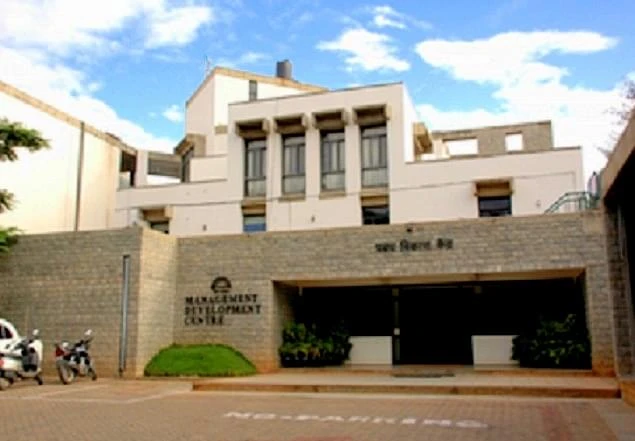

 Auditorium
 Cafeteria
 Computer Labs
 Gym
 Hostel
 Medical
 Science Labs
 Sports Complex
 Study Library
A large Bengaluru campus shapes day-to-day study
IIM Bangalore describes its campus as a 100-acre site with a 54,000-square-metre complex in the city’s knowledge district. The institute identifies architect B. V. Doshi as its designer and says the original stone campus was completed in 1983. That scale matters to a student’s daily routine: classes, study and campus life are organised around an extensive institute setting rather than a compact city-centre teaching block. The source does not publish walking distances between buildings, room capacities or a current campus map in the captured page, so applicants should check the current campus tour or contact the programme office for practical access details.
The architecture is not just a visual feature in the institute’s presentation. IIMB says its academic and administrative blocks have become a case study for architecture students and practising architects. Applicants choosing a management programme should read that as a description of the campus environment, not as a claim about classroom technology, teaching quality or the suitability of a particular course.
The institute also presents a campus tour as a way to experience the stone architecture and the living-and-learning setting. A visit can help prospective students understand the physical environment better than a list of facilities, but the captured page does not state tour dates, visitor eligibility or whether all programme areas are included. Check current tour arrangements before travelling, and use a programme contact for questions about restricted or student-only spaces.
Learning spaces: auditorium and library, with details to verify
The institute’s Life at IIMB page identifies an auditorium and a library as core campus facilities. It describes the auditorium as a teaching venue and the library as holding a collection of books. The page does not give current seating capacity, opening hours, catalogue size, electronic-resource access, lending rules or whether every programme cohort has identical access. Those are useful questions to confirm if a student expects late-night study access, specialist databases or a particular teaching format.
For applicants comparing programme formats, the campus page should be read alongside each programme’s own description. IIMB lists the two-year PGP and PGPBA as full-time programmes, the EPGP as a full-time residential programme, and the PGPEM as a programme for working professionals. The facilities page does not set out housing entitlement or day-to-day access for each cohort. Do not assume that one programme’s residential arrangement, schedule or student services automatically applies to another.
Sustainability features are named, but not quantified
IIMB’s campus page names rooftop solar installations, motion-sensor-based lighting, water-management systems and zero-waste initiatives. These are useful indicators of the institute’s stated infrastructure priorities. The page does not provide generation figures, water savings, waste-diversion rates, commissioning dates or an independently verified environmental performance series. Applicants can therefore use these details to understand the features the institute highlights, but not to estimate the campus’s energy or water footprint.
The 100-acre setting and the sustainability features also do not establish how buildings are distributed, which routes are accessible, or what transport is available within or beyond the campus. Students with mobility, health or commuting requirements should request current, programme-specific information directly instead of inferring it from the campus description.
Student life and campus fit
IIMB describes student life as extending beyond classes and points to student-run clubs and organisations spanning finance, entrepreneurship, sports and the arts. Its page reports more than 1,500 such clubs and organisations; it does not explain the counting method or how many are active in a given year. Treat that figure as the institute’s published description, not a verified count of currently operating groups. The practical takeaway is that extracurricular activity is part of the campus experience the institute promotes, while access and participation will depend on a student’s programme, schedule and the current student body.
The campus description is strongest on physical scale, architectural identity, named learning spaces and broad student-life themes. It is thinner on operational details students often need before accepting an offer: accommodation allocation and cost, dining arrangements, health services, sports facilities, accessibility provisions, library hours and programme-specific access. Ask the relevant programme office for those current details, especially where a decision depends on residential status or a specific service. The published page gives a useful sense of IIMB’s setting, but it is not a complete facilities inventory.