
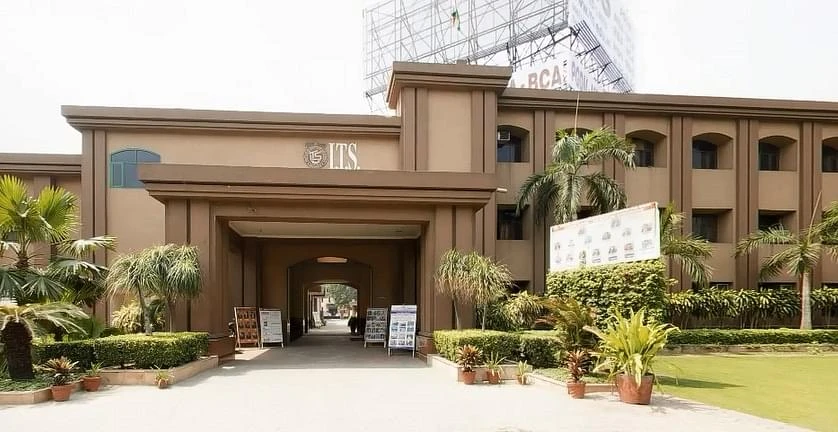
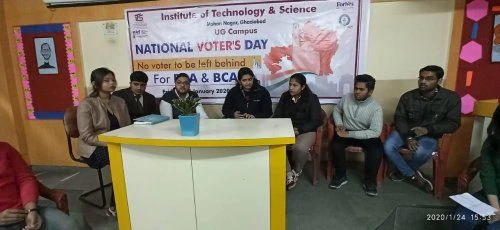




ITS UG Campus lists two academic recognition schemes for its BBA and BCA students: a batch-wise meritorious award and a section-wise performance-improvement award. The published pages give useful selection signals and, for the meritorious scheme, cash-prize tiers. They do not publish an application form, a current academic-year schedule, a full calculation rule or a need-based tuition-waiver policy. Treat these as institutional award descriptions, not guaranteed aid for the 2027-28 intake.
Meritorious award: top 10% in each academic year
The Meritorious Award Scheme says the top 10% of students from each academic year are identified batch-wise on academic performance. The listed award components are a medal, a certificate of achievement and a cash prize. The page then divides selected students into three equal groups: the top third receives ₹7,500 per student, the next third ₹5,500 and the remaining third ₹2,500. The source does not state whether “academic year” means each programme year, how the top 10% is calculated when class sizes or marks are tied, whether BBA and BCA are ranked separately, or which examination results determine the award.
The monetary values are published prize amounts, not a percentage reduction in tuition. Do not subtract them from a fee schedule when estimating the cost of enrolment. The website does not say whether these awards are applied to a student account, paid in cash, or subject to acceptance or documentation. It also does not publish the number of awardees, the date of selection, or a deadline to claim a prize. Those details should be confirmed with the campus before they are included in a personal budget.
Performance improvement: progress across paired semesters
The separate Performance Improvement Award is described as a section-wise award. ITS says the top 10 students from each section are selected for noticeable academic improvement over two consecutive semesters. The stated comparisons are Semester 1 to Semester 2 and Semester 3 to Semester 4; assessment looks at the positive difference in marks or grades. This describes recognition for improvement, not an entrance scholarship. It does not say that an applicant receives the award at admission or that the award is a fixed cash benefit.
The published criteria do not define “noticeable improvement,” provide a minimum mark increase, specify whether marks and grades are converted to a common scale, or state how ties are resolved. It is also unclear whether the top 10 students are chosen from each BBA/BCA section separately, whether improvement is measured only between the named semester pairs, and whether students must pass every paper. The source names the comparison periods but gives no current academic-year schedule, award value or application process. A student should not assume that a high absolute score alone qualifies: the page describes relative improvement, which is a different test from ranking in the top 10% by academic performance.
What the pages do not establish
These two schemes should not be treated as evidence of a means-tested scholarship, a reserved-category award, a government scholarship, a sports grant or a tuition waiver. The pages reviewed do not publish household-income limits, caste or disability eligibility, a scholarship amount linked to tuition, renewal conditions, combination rules, required documents, application deadlines or an appeal process. This does not establish that no other support is available; it means that the two linked award descriptions do not answer those questions. ITS should confirm any separate central, state or institutional aid route in writing for the relevant programme and intake.
The meritorious scheme and improvement award also use different selection bases. One identifies a percentage of a batch by academic performance; the other identifies a fixed number of students per section for progress across specified semester pairs. They cannot be compared by their cash values because only the meritorious page states amounts, and the improvement award page does not describe a monetary component. Nor do the pages explain whether a student may receive both awards, whether selection repeats in later years, or whether an award is held if a student changes programme or section.
Questions to ask before counting on an award
Before accepting an offer, ask the ITS UG admissions office for the written 2027-28 policy that applies to the exact BBA or BCA programme. Request confirmation of the academic year and cohort covered, the denominator used for the top 10%, the treatment of ties and backlogs, and the semester result date on which awardees are selected. For the improvement award, ask whether “top 10 students” means the ten largest mark/grade increases in each section and how differing subject loads are compared.
Also ask how and when money is disbursed, whether a student must submit an application, whether payment is made to the student or adjusted against fees, what records are required, whether the two schemes can be combined, and whether any award must be returned after withdrawal. The published pages provide no answers to these operational questions, so do not infer terms from the word “scholarship” in a navigation label. Save the reply or circular with its date and intake year; verbal guidance may not resolve which version applies later.
Budgeting and next step
Plan using the official fee amount for the course and period, without assuming either award. If an award is later confirmed, treat it as a possible benefit whose eligibility and payment timing still need to be met. A ₹7,500, ₹5,500 or ₹2,500 prize may be useful, but the source does not say whether it recurs or offsets a full-year charge. A projected household budget should therefore distinguish the published fee due from a prize that has not yet been awarded.
The official pages identify the two schemes but are not dated to the 2027-28 intake. Contact the admissions office through the ITS UG website and request the current written scheme and application route. Ask for programme-specific confirmation rather than assuming that a general page applies identically to every student. Recheck the policy before fee payment and again when the relevant semester results are declared. As of 5 November 2026, the evidence supports the described academic award rules and prize tiers, but not a guaranteed 2027-28 scholarship, tuition reduction or payment date.