
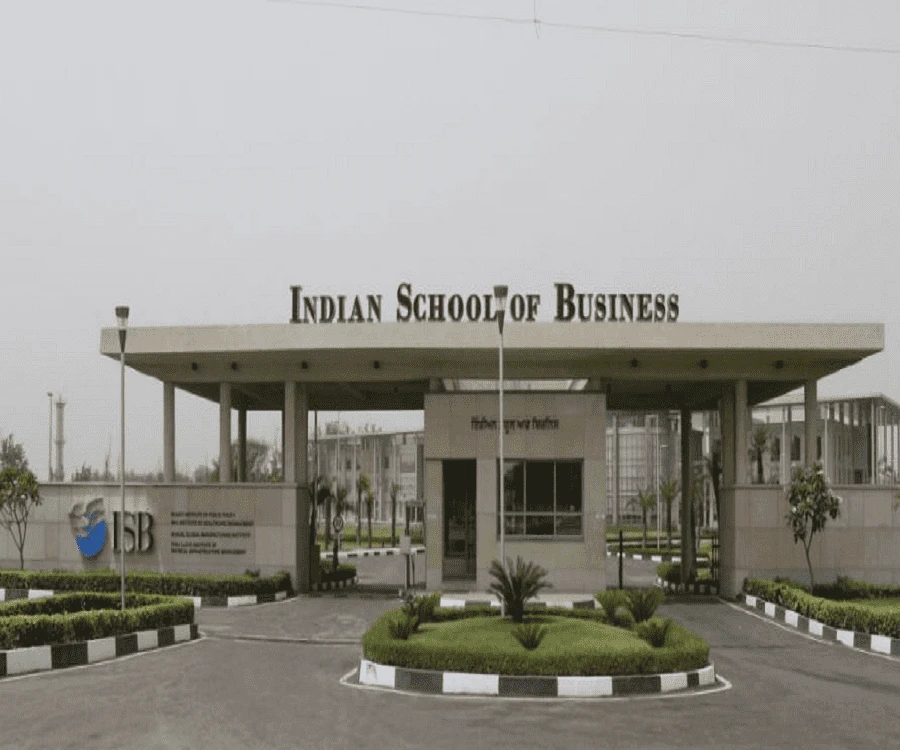



ISB PGP placements: the latest reported outcome
ISB's latest published outcome is for the 2026 graduating class of its one-year, full-time PGP. The school reports an average salary of ₹37.29 lakh per annum and a highest offer of ₹1.56 crore per annum. These are two different measures: the average describes the reported cohort mean, while the highest offer is a single upper-end result. Neither figure is a median, and the public material reviewed here does not establish how many graduates received each offer level. Read the Class of 2026 graduation and placement release alongside ISB's recruiter and placement page, rather than treating the top offer as a typical outcome.
The graduation release says 808 students graduated from PGP Class of 2026 at ceremonies held across Hyderabad and Mohali. The recruiter's page and its linked 2025–26 placement report describe 812 students enrolled in the Class of 2026. These figures refer to different stages, graduation and enrolment, and should not be used as interchangeable denominators. ISB describes the two campuses as following a unified placement process. The outcomes therefore belong to the combined PGP cohort; ISB does not publish a separate Hyderabad-campus salary or placement rate in these sources.
Offers, graduates and the count that does not reconcile
There is a material difference between two current official offer totals. The graduation release says the PGP Class of 2026 received 1,117 job offers. The recruiter page displays 1,177 offers made for 2026, alongside 282 companies. The page does not explain whether the additional 60 offers reflect a later update, a different counting rule or an error. Both numbers are retained with their source and scope here; neither should be silently substituted for the other. Applicants comparing cohorts should check the date and definition attached to a figure and look for a later reconciled placement report.
An offer count is not a count of people placed. The available sources do not give a number of unique students placed, participating students, eligible students or a placement-rate denominator. The 2025–26 PDF available from the recruiter page is titled Placement Report 2025–26, but its detailed placement tables cover Co2025; its Co2026 page is a class profile. It does not reconcile the current offer totals or provide a Co2026 placement rate. No rate can responsibly be calculated by dividing offers by the 808 graduates or 812 enrolled students. ISB also reports a two-offer policy for Co2025, which further illustrates why offer totals and people placed are not interchangeable.
Hiring mix and career movement
For Co2026, ISB identifies consulting, technology and banking, financial services and insurance (BFSI) as the main hiring sectors. The release names Accenture as making more than 100 offers, while Mastercard and EY GDS each made more than 40. It also lists firms including McKinsey & Company, BCG, Bain & Company and Deloitte in consulting; Amazon, Google, IBM, Uber and other firms in technology; and a range of investment, banking and private-capital employers in BFSI. These are examples named by the school, not a complete recruiter list or a guarantee that a role will be available in a later class.
ISB says 25 first-time recruiters joined Co2026 placements. It reports 30 international offers, compared with 26 for Co2025, and says 67% of Co2026 students moved to a new industry while 69% shifted to a new function. These are measures of career movement, not placement rates. The school does not publish the underlying student-level cross-tabulation in the release, so the percentages should not be added together or interpreted as separate groups.
The older Co2025 placement report provides more detail on function and industry distributions. It records 63% of students moving to a new industry and 59% to a new function. The reported Co2026 figures are higher by four and ten percentage points respectively. This is a comparison of two school-reported percentages, not evidence that the programme caused the change or that the cohorts are identical in composition. Co2025's report also says business and strategy consulting accounted for 34% of overall placements and BFSI for 12% of offers; its wording uses different bases, so those shares should not be compared as if both measured the same denominator.
What the 2025 report adds
The official Placement Report 2025–26 reports 816 students in Co2025, 364 companies registered for campus placements and 1,164 job offers. It lists consulting, FMCG and retail, technology, and finance among the leading industries by offers. More than 60 first-time recruiters made over 180 offers, and 37 companies extended international offers. The report says more than two-thirds of the class transitioned to a new function or industry; its detailed statistics page separates those movements into 63% by industry and 59% by function.
The report describes business and strategy consulting as 34% of overall placements, and BFSI as 12% of total offers. Its sector chart also identifies technology as a major hiring area, but the report does not provide a directly comparable Co2026 sector-share table in the pages reviewed. Treat the Co2025 distribution as historical context, not a forecast for the next intake. The report includes examples of roles such as business strategy, brand management, product management, general management, investment advisory and technology consulting, alongside named recruiters. Those examples show the breadth of the reported functions, but do not establish individual placement probabilities.
How applicants should use these figures
For an applicant considering the Hyderabad campus, the practical point is that ISB reports outcomes for a unified two-campus PGP process, not campus-specific results. The published Co2026 mean and maximum are useful as cohort-level reference points, but ISB does not provide a Co2026 median, unique-student placement count or placement-rate denominator in the sources reviewed. The average is not a promise of an individual salary, and the highest offer is not a sensible budget or return-on-investment assumption. Compare the programme's full cost with your own pre-ISB compensation, work experience, target role and financing plan rather than using the maximum offer as a likely outcome.
The recruiter page describes a year-long career-advancement process that includes recruiter interactions and pre-placement talks. This explains how students encounter potential employers; it does not quantify how many students secured offers through each activity. ISB's public summaries are strongest on cohort compensation, offer totals, selected recruiters and career-movement percentages. They are less complete on unique placements, salary distribution, industry-by-function outcomes and campus-specific results. Those gaps matter when comparing schools: request a clearly defined median and denominator, or use only figures that share the same cohort and reporting basis. The placement information here applies to the flagship PGP and should not be transferred to PGP YL or other ISB programmes without programme-specific reports.