
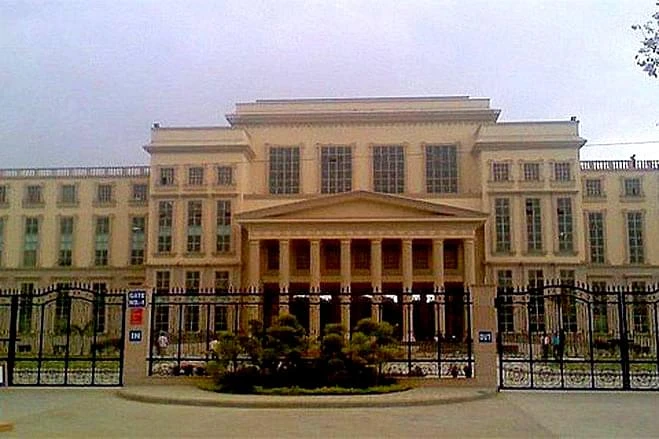

 Auditorium
 Cafeteria
 Computer Labs
 Gym
 Hostel
 Medical
 Science Labs
 Sports Complex
 Study Library
ASFT campus and facilities: studios, laboratories and student use
The official Amity School of Fashion Technology infrastructure page identifies two design studios, two garment-construction laboratories with industrial machines, textile-testing and fabric-manufacturing laboratories, a library and computing room. It also lists a herbal garden with a greenhouse. These are the concrete ASFT-specific spaces captured for this update. The source page does not state room capacity, operating hours, access rules, software inventory, machine counts or which cohorts use each space, so applicants should confirm those details for their programme and semester.
Design studios and garment construction
ASFT lists two design studios and two garment-construction labs. The school’s page describes industrial machines in the garment labs, indicating that these are intended as practical making spaces rather than only lecture rooms. The captured material does not enumerate machine brands or types, class sizes, open-studio hours or the amount of time a student can use the rooms outside scheduled sessions. A visit or written response from the department can help establish whether the actual schedule matches your expectations.
Ask which B.Des programmes use each studio and construction lab, at what stage of the course students begin practical work, and whether access is scheduled in small groups. If you are comparing Fashion Design, Fashion Technology, Textile Design or Fashion Communication, request the current curriculum and a recent project brief. The space list alone does not show how the course distributes design, construction and presentation work, or whether students have individual access to machines and materials.
For a prospective student, useful questions include whether basic materials are included in tuition or purchased separately, whether there is a safety induction, who supervises equipment use, how machine maintenance is handled and whether students need to book time for independent work. The official infrastructure description does not answer those operational questions. They can affect practical project costs and workflow, so request a current student handbook or studio-use policy rather than assuming access based on a facilities list.
Textile testing and fabric manufacturing
The official page names textile-testing and fabric-manufacturing laboratories. These facilities are relevant to hands-on study of materials and production, but the captured source does not list test methods, instrument models, production equipment or accreditation. Avoid assuming that the lab offers a particular commercial test, industrial certification or a full-scale production line unless the school confirms it.
Ask how the labs are used across the Textile Design and Fashion Technology curriculum, whether students conduct supervised testing or mainly observe demonstrations, which materials are available for coursework, and how results are documented. If your interest is fabric development, material quality or apparel production, ask the department for a recent module outline and a student project that shows the lab’s role. The school should identify what is available during the year you intend to join, since equipment can change or be under maintenance.
Library, computing room and greenhouse
ASFT’s infrastructure page lists a library and a computing room. It does not specify opening hours, collection size, electronic-database access, workstation count, installed applications or off-campus access. Applicants who expect to use specialist fashion or textile references should ask whether the ASFT library holds course-specific collections, how students access the wider Amity library system, and what support is available for digital design or research tasks. The presence of a computing room does not establish which software is licensed or whether students can use it outside class.
The same page lists a 60-acre herbal garden with a greenhouse. This is an unusual campus resource, but the source capture does not describe scheduled ASFT teaching there. Ask whether any design, textile, sustainability or material-study modules use the garden or greenhouse, who can access it and whether it is available for student projects. Do not assume that a campus feature is part of the fashion curriculum simply because it appears on an infrastructure page.
Industry interaction and student work
ASFT’s about page describes industry and designer interaction and a 6-8 week summer training or project. That is a programme-exposure description, not proof of a specific placement, paid internship or guaranteed access to a particular employer. Ask who arranges the activity, whether it is compulsory, how it is assessed, what travel or material costs students may bear and whether the project can be completed with a local organization.
Dated student showcases give additional context about work beyond a facilities inventory. The school’s KREATIV ’26 page describes a March 2026 final-year Fashion Design collection presentation with five collections. A separate 2025 participation report records 19 outfits attributed to ASFT Noida at a joint Delhi Times Fashion Week event. These examples show event participation in those years; they do not show that every student presents work or that the same event recurs annually. Ask how students are selected for showcases and what other ways exist to present projects.
Verify the facilities you will actually use
Before accepting an offer, ask for a programme-specific campus tour or a current facilities briefing. Check the two design studios and garment labs, and ask to see how textiles are tested or fabricated if those activities matter to your course choice. Confirm which spaces are available to first-year students, whether there are scheduled practical sessions, how lab access changes in later years and whether consumables or equipment charges are billed separately.
For daily services not described in the captured ASFT infrastructure source, such as accommodation, dining, health support, sports, transport, security and accessibility, verify the current university-level policy and the exact campus location. This page does not confirm hostel room types, cafeteria arrangements, medical hours, transport schedules, CCTV or ID-card systems. Ask about these needs directly and request current written details, especially if you are relocating or need an accessibility accommodation.
Facilities should be judged together with the curriculum and support offered to students. A room list tells you that a resource is named, not how frequently students use it or what they learn there. Compare the module plan, project examples, supervision, access rules, costs and student work for your chosen programme. That gives a more useful picture than assuming a particular machine, service or outcome from a general campus description.