Loading Admission Guardian content
Loading Admission Guardian content

1 programme · 1 institution. Check the admission year and requirements.
1 programme · 1 institution. Check the admission year and requirements.
Compare 30 available cutoff records across 1 exam, with course, category, counselling round and year kept separate.
Compare cutoffs for the same course, quota, category, domicile and round.
Review the exam and course requirements before using a cutoff to plan your application.
View JEE-Main exam details1
2021-2025
13
30
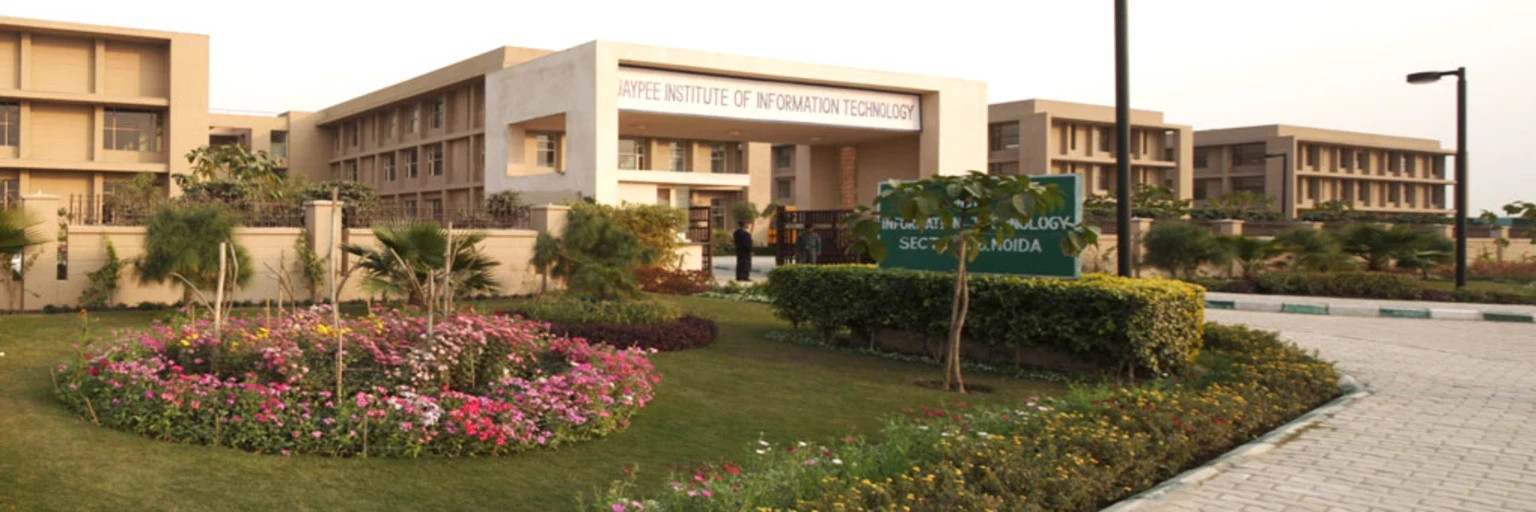
Jaypee Institute of Information Technology University (JIIT) (JIIT Noida) in Uttar Pradesh has historical cutoff records for JEE-Main on this page. There is no single cutoff for the whole college: read each course, category, quota and round separately. Coverage below reflects the records on this page.
The latest recorded year is 2025. 7 records in that group cover 1 named category. Across the available years, 13 distinct course labels are recorded.
Showing 5 of 7 profiles, ordered by course and category. Browse every loaded record in the full table above.
Recorded years: 2021-2025. Year changes appear only for single closing values with matching course, category, quota, round, counselling context and unit.
Jaypee Institute of Information Technology (JIIT), Noida publishes cutoff and merit data for more than one admission route. Its official cutoff page currently shows the Academic Year 2026-27 cutoff merit table, updated 24 September, and also gives historical Class 12 merit and JEE Main rank ranges for 2023, 2024 and 2025. The 2026-27 page also says admissions are closed. These figures help explain how selection has worked; they are not a prediction or a live seat-availability list.
The table labels its campus values as JIIT62 and JIIT128. It separates B.Tech and integrated programmes, branches, JEE All India Rank (AIR) ranges, and Class 12 marks. The published page does not define every abbreviation beside each row, so keep the campus codes and branch names as shown when comparing your application route. Do not treat similarly named programmes across the two campus codes as identical cutoffs.
The latest table lists separate minimum and maximum JEE AIR and Class 12 marks for a set of programme and campus combinations. For JIIT62 B.Tech CSE, the displayed JEE AIR range is 12,948 to 92,154 and the 10+2 range is 94.33% to 99.83%. JIIT128 B.Tech CSE is shown with a JEE AIR range of 49,858 to 195,352 and Class 12 marks from 87.33% to 96.33%. These are the page’s reported ranges, not guaranteed thresholds for a future counselling round.
The differences are visible across branches too. JIIT62 B.Tech IT is listed at 56,504–104,461 JEE AIR and 93.33%–97.00% in Class 12. JIIT62 B.Tech Biotechnology is listed at 193,777–220,616 JEE AIR and 61.20%–95.60%. The JIIT128 AI & ML row shows 33,906–215,286 JEE AIR and 87.00%–98.00% Class 12 marks. An applicant should compare the exact programme and campus row, rather than carrying one branch’s figures over to another.
The page also lists integrated CSE and ECE, and specialist options such as Robotics & AI, Electronics and Communication (ACT), and Electrical Engineering (VLSI). Integrated CSE at JIIT62 is shown at 26,137–151,868 JEE AIR and 88.67%–95.33% Class 12 marks. The table includes biotechnology and integrated biotechnology routes as well. The mix of routes means that “JIIT cutoff” is not one number.
The official page places previous-year JEE Main minimum and maximum ranks beside campus and branch. For JIIT62 B.Tech CSE, it records 18,185–65,607 in 2023, 17,438–73,836 in 2024, and 12,458–92,207 in 2025. That widening and movement show why a past rank should not be read as a fixed admission promise. Candidate pool, seat choices, counselling and programme demand can change between years.
The JIIT128 B.Tech CSE row records 46,290–128,693 for 2023, 63,684–140,657 for 2024, and 71,012–263,583 for 2025. JIIT62 ECE is shown at 54,748–210,800 in 2023, 64,743–247,410 in 2024, and 64,600–382,452 in 2025. Other branches have a shorter history; a dash means the page does not display a rank for that year and row. It should not be converted into zero or evidence that the programme did not exist.
The same page separately displays Class 12 merit ranges for 2023, 2024 and 2025. These are percentages, not JEE ranks. It also uses slightly different branch labels across sections, such as “AI & ML” in the current table and “AIML” in earlier rank rows, and it lists an IT historical row under J62/J128. Preserve those labels when reading the source rather than assuming the older row maps one-to-one to a currently named specialization. The cutoff page does not explain whether every label change reflects a renamed programme, a revised curriculum or a change in campus allocation. For instance, JIIT62 CSE is listed at 95.33%–100% in both 2023 and 2024 and 94.00%–99.67% in 2025. Keep those percentages distinct from the JEE AIR ranges when using the page to plan an application.
Start with the admission route you intend to use, then match the exact campus code, programme and branch. Check the current admissions procedure for the year you are applying, since JIIT’s cutoff page is historical/edition-bound and its current admissions banner says the 2026-27 cycle is closed. If the application uses JEE Main, compare your AIR with that route’s table; if it uses Class 12 merit, use the percentage columns. Do not compare a percentage to an AIR or combine the two routes into a single threshold.
A historical range is best treated as context. A rank inside an earlier range does not guarantee a seat, and a rank outside one published minimum or maximum does not establish that a later round or another admission route will be unavailable. The official page does not identify current 2027-28 cutoffs, counselling rounds, category-wise thresholds or live vacancies. Those remain unknown until the university publishes the relevant cycle’s data.
Before submitting preferences, review the live JIIT admission procedure and counselling notices for the exact intake. Use the official cutoff page as a comparison aid, and confirm any branch or campus code that is unclear with the admissions office. This article preserves the published 2026-27 and 2023-25 data as dated evidence; it does not estimate a future cutoff.