Loading Admission Guardian content
Loading Admission Guardian content

5 programmes · 1 institution. Check the admission year and requirements.
5 programmes · 1 institution. Check the admission year and requirements.
National Institute of Technology Goa is a centrally funded, autonomous Institute of National Importance under the Ministry of Education. It was established in 2010 and now operates from its permanent campus at Kottamoll Plateau in Cuncolim, South Goa. The permanent campus was inaugurated on 6 February 2024 after the institute’s transit-campus years. NIT Goa is therefore a young NIT with a newer residential campus, not a long-established urban campus. Official institute profile · 2025-26 admission brochure Its five undergraduate engineering choices are concentrated in core and computing disciplines, which can suit applicants seeking a smaller institute with close access to departments.
The campus setting is a practical choice, not just a postcard detail. NIT Goa places the campus about 15 km from Margao, around 38 km from Dabolim Airport and around 77 km from Manohar International Airport at Mopa. Madgaon is the closest major railway station, also about 15 km away. Applicants should plan arrival and term-time travel around the Cuncolim location; the institute’s distance figures do not establish a public-transit timetable or routine campus shuttle service.
The official website identifies NIT Goa as an Institute of National Importance and lists Government of India and Ministry of Education oversight. No current NAAC grade or rating was established in this review, so none is stated here.
NIT Goa’s undergraduate catalogue lists five four-year B.Tech programmes: Computer Science and Engineering (CSE), Electronics and Communication Engineering (ECE), Electrical and Electronics Engineering (EEE), Civil Engineering (CVE) and Mechanical Engineering (MCE). The institute’s published intake description assigns 44 seats each to CSE, ECE and EEE, and 42 each to Civil and Mechanical, for a stated total of 216 B.Tech seats. NIT Goa programme and intake details The same page breaks the figure into 188 seats through JoSAA/CSAB and 28 through DASA. These are the institute’s published intake figures, not a promise that the 2027-28 seat matrix will remain unchanged.
At postgraduate level, the institute lists M.Tech programmes in CSE, VLSI and Power Electronics and Power Systems, alongside Ph.D. study across engineering, applied sciences, technology and humanities and social sciences. Its about page reports an M.Tech intake of 80 across the three disciplines. Applicants should use the department and current admission notice for the programme-specific eligibility and route; the B.Tech route does not describe postgraduate selection.
For Indian candidates seeking B.Tech admission, NIT Goa’s JoSAA/CSAB page identifies JEE (Main) 2026 and says admission includes performance in the qualifying examination and JEE Main. Seat allocation is through the common counselling process, with CSAB special rounds covering later vacancies where applicable. The institute also lists a DASA route, whose rules and applicant eligibility differ. NIT Goa admission procedure A JoSAA allotment is not the final on-campus registration step: the 2026-27 instructions required newly allotted candidates to complete institute MIS and e-Samarth registration, then attend physical reporting with original documents.
Those dates are historical. For 2026-27, NIT Goa scheduled physical reporting for 15-18 August 2026 and required reporting by the deadline; the new-student portal window in that notice ran 10-18 August. Official 2026-27 reporting instructions These dates have passed. As of 1 November 2026, the institute’s published B.Tech instructions concern the 2026-27 intake; no general 2027-28 B.Tech schedule was located in the reviewed official notices. Do not reuse last year’s reporting dates or infer next year’s JEE, counselling or document deadlines. Check the NIT Goa admissions page, JoSAA and CSAB for the next official cycle.
The institute’s physical-reporting notice for the 2026-27 B.Tech intake lists first-semester institute fees of ₹84,000 for GEN/OBC/EWS candidates and ₹21,500 for SC/ST/PwD candidates. It separately states a first-semester hostel fee of ₹44,250 for hostellers, including mess. A simple addition gives ₹1,28,250 for a GEN/OBC/EWS hosteller before any applicable tuition remission, or ₹65,750 for an SC/ST/PwD hosteller; those are first-semester examples only, not a full-year or four-year quotation. The notice also shows that counselling payments and balances affect what a student pays at physical reporting, so the first-semester institute amount should not be confused with the balance due at that visit.
The fee notice describes tuition relief for the same 2026-27 intake. GEN, GEN-EWS and OBC-NCL students with family income below ₹1 lakh per year could claim refund of the full ₹62,500 tuition component; for family income from ₹1 lakh to ₹5 lakh, the notice specifies a two-thirds tuition refund of ₹41,667. SC/ST/PwD students are exempt from tuition under the notice. NIT Goa states that eligible students initially pay the full first-semester fee, with the waived amount refunded after the institute receives the relevant amount from JoSAA/CSAB and verifies the documents. The notice calls for current income documentation and supporting records. Eligibility and payment timing should be checked against the actual intake’s notice.
These are dated first-semester figures, not a current 2027-28 schedule. Use the dated reporting notice as a first-semester reference, not a current 2027-28 quotation. It does not establish the complete later-semester charges, a four-year total, or whether every applicant receives hostel accommodation. Before accepting an offer, confirm the current fee circular, hostel allotment and the amount payable after counselling adjustments with NIT Goa.
NIT Goa’s Training and Placement Cell publishes a 2025-26 B.Tech report with branch-wise eligible and placed counts. Official 2025-26 placement report Across the five branches, it reports 90 placements among 99 eligible students, or 90.91%. That percentage is calculated from the report’s eligible-student denominator; it is not the share of the whole graduating class or a guarantee for an incoming student. The report also labels package averages and maxima separately. Its overall figures are an average package of ₹10.75 lakh per year and a maximum of ₹28 lakh per year; neither is a median.
The same cell’s 2024-25 report recorded 74 placements among 90 eligible students (82.22%) and an ₹8.10 lakh average. Official 2024-25 report On those two annual reports, the eligible-student placement rate rose by 8.69 percentage points and the reported average rose by about 32.7%. The comparison is descriptive: cohort sizes and branch mix changed, and the reports do not establish why the measures moved. Check the branch row rather than treating the overall average as an individual outcome.
These rows describe a placement process, not a probability that a new student will receive an offer. The denominator is eligible students in each branch, rather than all enrolled students; the report does not make the unplaced count equivalent to students who were actively seeking a job. Cohort sizes are small: one additional placement changes the Civil row by 10 percentage points and the CSE row by about 3.6 points. Read the counts alongside each percentage, and do not treat a one-year branch order as a stable forecast. The reported package figures also describe placed students and use the report’s own salary measure; they do not show take-home pay, recurring compensation or a guarantee for the next graduating batch. Applicants can use the table to frame questions for the placement cell: how eligibility is defined, whether higher studies and other choices are included, how offers are counted, and whether branch-wise figures cover the same placement period. The reports provide observed outcomes, not those additional definitions or student-level distributions. For a decision, compare the branch you are considering with its own count, average and maximum, then compare that with curriculum, location and the total cost for your category. An average can be pulled upward by a small number of high offers, while the maximum shows only the top reported offer; neither describes the middle student. The NIRF median is a more suitable central measure for its stated cohort, but its earlier graduation year and institution-wide scope still make it a different comparison. Ask the institute for a matching branch and graduating-year median if that is central to your choice.
A separate NIRF 2025 institutional submission reports the four-year UG cohort graduating in minimum stipulated time in 2023-24: 166 graduates, 105 placed, 15 selected for higher studies and a median salary of ₹7.25 lakh per year. NIRF 2025 data submission This is an institution-wide NIRF cohort metric and a median; it is not the same measure or cohort as the placement cell’s 2025-26 average-package report. It should not be substituted for a branch median.
For rankings, the latest verified NIRF Engineering result located here places NIT Goa in the 101-150 band in 2025. It was also in the 101-150 band in 2024. NIRF 2025 · NIRF 2024 The band does not disclose an exact position within it, so comparisons that assign the institute a single rank or claim a precise year-on-year rise or fall overstate what this result says. A ranking is one reference point, not a measure of branch-level teaching or a placement guarantee.
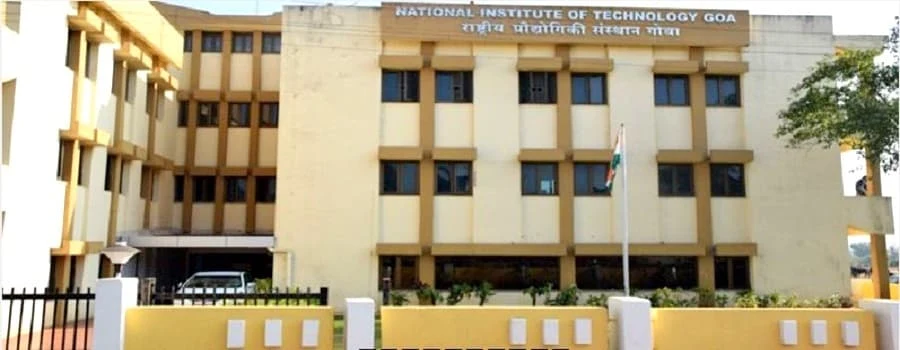
NIT Goa describes its permanent campus as a 114-acre site with academic, tutorial, seminar and administrative complexes, a health centre, sports ground and other utilities. 2025-26 admission brochure The institute lists departmental laboratories and workshops, a library, classrooms with audiovisual equipment, and hostel accommodation with mess and Wi-Fi. Its hostel facilities page describes separate boys’ and girls’ hostels with wardens, study and recreation spaces, dining and sports facilities. The institute’s facilities page lists medical support and ambulance services. Room availability, current hostel charges and service details should be confirmed with the institute for the relevant intake.
The five-branch B.Tech portfolio and reported small eligible placement cohorts make branch-level comparisons especially important. Applicants who want CSE, ECE, EEE, Civil or Mechanical can compare NIT Goa’s official curriculum and placement rows for that branch, then weigh the residential campus and location against other offers. Students seeking a broad range of undergraduate disciplines, a city-centre campus or a four-year cost estimate from a single dated fee number should verify those points before ranking options.
A practical shortlist should therefore use three current documents: the official programme and counselling notice for the applicable year, the fee and hostel circular for the student’s category and payment period, and the latest branch-wise placement table. NIT Goa offers a clear set of engineering choices and a permanent campus; the evidence reviewed here does not justify a guarantee about future cutoffs, costs or individual job outcomes.
Loading programmes and admission routes.
Selected ranking categories, with the recorded year beside each result. Open all records for the complete history.
12 published records · Lower numeric ranks are stronger
NIRF
B.Tech
#772020
IIRF
Engineering · public
#632023
IIRF
B.Tech · public
#632023
Find a program, read its fee details and explore the admission requirements.
Summary of the programs shown below. First-year fee
| Course | Stream | Fees |
|---|---|---|
| Ph.D | Engineering | 32200 |
| Ph.D. | Science | 32200 |
| Master of Technology [M.Tech] | Engineering | 87200 |
| Bachelor of Technology [B.Tech] | Engineering | 143200 |
Specializations
Eligibility: Postgraduation
Specializations
Eligibility: Postgraduation
Specializations
All accepted exams
Eligibility: Graduation + GATE
Specializations
All accepted exams
Eligibility: 10+2 + JEE Main
3 exams with cutoff data available - showing recent entries
 Aircel
 Amazon
 Analytics Quotient
 Asus Technology
 BARC
 Barclays Bank
 Bayer Crop Sciences
 Bharat Electronics Limited
 Bharat Heavy Electricals Ltd. (BHEL)
 Bosch Ltd
 Cerner
 Goa Shipyard Limited
 HP India Pvt. Ltd.
 IBM
 IFB
 Intel
 Intellect Design Arena Ltd
 Larsen & Toubro Limited
 MRF
 ONGC
 Persistent Ltd
 Polaris
 Samsung
 Siemens
 Syngenta Biosciences
 Tech Mahindra
 Unisys
 World Quant
 ZUARI


In this preview: 2 photos · 0 videos
There is no single source-backed answer to which college is better for every student. Compare the specific programme, fees, admissions route and placement outcomes using the same graduating year, branch scope, denominator and salary measure. NIT Goa's official 2025-26 placement report lists a CSE average of ₹13.07 lakh per annum for 27 placed students out of 28 eligible; that figure alone does not establish a like-for-like comparison with GEC.
Yes, NIT Goa moved to its permanent 114-acre campus located in Cuncolim, South Goa, in the year 2024.
NIT Goa's official 2025-26 B.Tech placement report records a CSE average package of ₹13.07 lakh per annum: 27 of 28 eligible students were placed, and the reported maximum was ₹28 lakh per annum. This is a report-year average, not a guarantee or a median.
Yes, NIT Goa has a significant home state quota. 40% of seats are reserved for candidates from Goa, with an additional 10% reserved for candidates from specific Union Territories like Daman & Diu.
Hostel life at the new permanent campus has seen significant improvement, offering single-room options and better facilities. However, as the campus is new, it is still in its initial "settling" phase.
About National Institute of Technology Goa.
Colleges cannot rewrite published reviews. We remove spam and abuse.
Ask the communityWhat should future students know?
Tell us which course you're considering. We'll help you work out the next step.
Get instant Partner access after mobile verification. Your public edits are reviewed before they go live.
Claim this collegeProgramme information: Official source · Source as of: 2026-11-01
Each route applies only to this named programme and the stated year.
JEE-Main: Joint Entrance Exam Main · 2026-27
Admission-route evidence: Official source · Source as of: 2026-11-01
Programme information: Official source · Source as of: 2026-11-01
Each route applies only to this named programme and the stated year.
JEE-Main: Joint Entrance Exam Main · 2026-27
Admission-route evidence: Official source · Source as of: 2026-11-01
Programme information: Official source · Source as of: 2026-11-01
Each route applies only to this named programme and the stated year.
JEE-Main: Joint Entrance Exam Main · 2026-27
Admission-route evidence: Official source · Source as of: 2026-11-01
Programme information: Official source · Source as of: 2026-11-01
Each route applies only to this named programme and the stated year.
JEE-Main: Joint Entrance Exam Main · 2026-27
Admission-route evidence: Official source · Source as of: 2026-11-01
Programme information: Official source · Source as of: 2026-11-01
Each route applies only to this named programme and the stated year.
JEE-Main: Joint Entrance Exam Main · 2026-27
Admission-route evidence: Official source · Source as of: 2026-11-01
5 recorded programmes · 1 institution. Admission years and conditions apply to the named programme.
 Auditorium
 Cafeteria
 Computer Labs
 Gym
 Hostel
 Medical
 Science Labs
 Sports Complex
 Study Library